
Roo Station / UNIT 06 RO06
Big POP Day
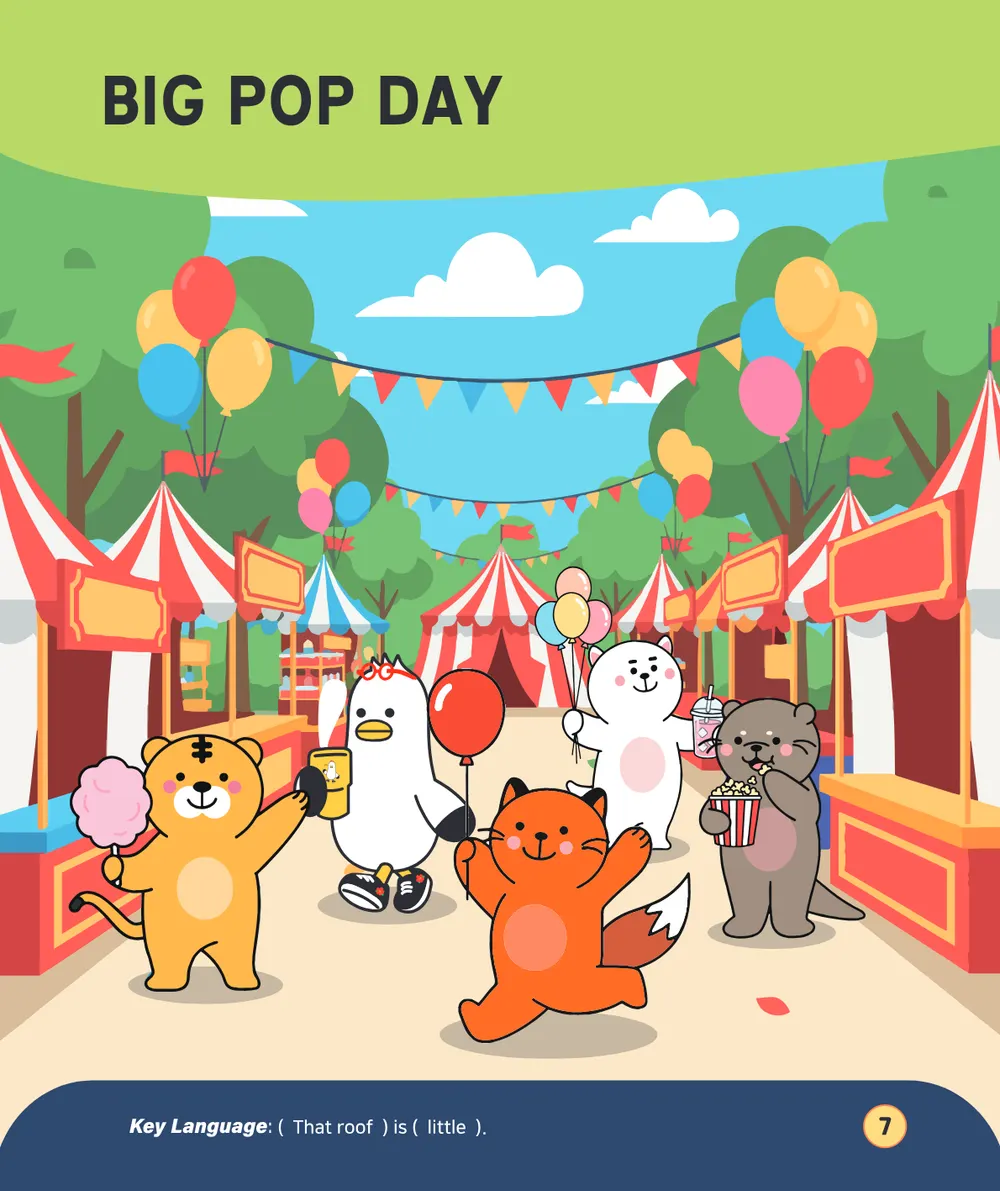
(That roof) is (little).
 LESSON 1
LET’S GET STARTED
Words and Story
Follow the shared lesson flow, with room to repeat, pause and play.
Start presentation Slides, audio and teaching notes in one place.Your lesson flow
Week 1 · Day 1- 01Routine
Hello & warm-up
Greetings, feelings, weather and the day.
- 02SB
introduce characters
Student Book · p. 4–5
- 03SB
unit introduction
Student Book · p. 7
- 04SB
vocab introduction
Student Book · p. 8
- 05SB
chant
Student Book · p. 9
- 06SB
story time
Student Book · p. 10–25
- 07WB
words
Workbook · p. 4
SING · MOVE · PLAY
A little more play
Built into your lesson. Repeat or skip to suit your class; keep time for the book and conversation.
More official songs & online games
Preview external pages before class. They open in a new tab and may need internet or show provider content.
- Walking Walking · movement song ↗Use before seated book work. Model actions in place.
- Starfall ABCs · letter exploration ↗Choose the lesson’s letter with your class. Best after introducing its sound.
- British Council · word games ↗Select the topic first; reading tasks need teacher help for beginners.
Our games add oral practice to the curriculum. They do not measure a child’s English level.
Teaching guide
Original Teacher’s Guide. Each 40-minute lesson covers two guide periods.
1. Words and Story
W1 P1Intro to class theme + Vocabulary — Student Book (Words)
Lesson Goals
- To introduce the main characters
- To introduce size concepts
Students will be able to
- Name the characters
- Understand and use size-related words through listening and practice
1. Warm-Up
Hello Song · “How are you?” · “How’s the weather today?” · Day of the week check
2. Introduce Characters (Student Book pg 4-5)
- a) Name & Identification. Point to each character and say the name clearly. “This is Boogi. Everyone say, ‘Hello, Boogi!’” “This is Otto. Can you say, ‘Hi, Otto’?” “This is Hoggy. Everyone, ‘Hoggy!’” Review: point to a random character and ask, “Who is this?”
- b) Engaging with Character Stories. “Who is the leader of the team?” (Boogi!) “Who likes to surf?” (Otto!) “Who is a food YouTuber?” (Hoggy!) “Who is Jindo looking for?” (Her owner!) “Tigo has a big imagination! What is he searching for?” (A mystery creature!)
- c) Personal Connection. “Which character is the coolest?” or “Who do you want to play with?”
3. New Unit Introduction (Student Book pg 7)
- Show the picture of the characters and the fair they are at. “Who is this character?” “What do they have?” “Are they big or small?” “What is Otto eating?” “Do you like popcorn?” “Do you like going to the movies?”
- Relate the picture to the students’ lives and ask if they have a favorite movie or one they watch a lot with their parents.
- “Today, we are going to read a very funny story about what happened when our friends went to the movies! Are you ready to find out?”
4. Vocabulary Introduction (Student Book pg 8)
- a) Introduction. Clearly pronounce the target words (movie, popcorn, tall, tiny, small, big, huge). Have students repeat with clear pronunciation. Show pictures in the book or flashcards as you say each word to build visual recognition.
- b) Comprehension Check. “Is the popcorn yummy?” (Yes!) “Is an elephant huge?” (Yes!) “Is an ant big?” (No!) “Is a giraffe tall?” (Yes!) “Is a movie screen small?” (No!) “Do we eat popcorn at the movies?” (Yes!)
- c) Physical Demonstration. Movie: mimic holding a camera or making a square frame with your fingers — “Let’s watch a movie! Shhh!” Popcorn: start with a small ball with your hands and quickly open them up — “Pop! Pop! Popcorn!” Tall/Huge: reach your arms up as high as possible, standing on tiptoes — “I am huge! I am so tall!” Small/Tiny: crouch down or make a tiny gap between your fingers — “I am small. I am tiny.” Big: spread your arms out wide — “This is big!”
- d) Personal Connection. “What is your favorite movie?” “Do you like Frozen? Who’s your favorite character?” “What food would you eat at the movie theater?” “Do you like eating popcorn at the movies?” “Have you seen a tiny bug before?”
- f) Game — Big Fish, Small Fish. i) Ask the students to stretch their hands forward to show “small” and then spread them wide for “big”. Practice these actions together several times. ii) Add animals to the words: “Small fish” (hands close together) and “Big fish” (arms wide open). Perform the actions with the students. iii) Announce “Now, we are going to do the opposite!” If the teacher says “Big fish,” the students must do the small fish action; if the teacher says “Small fish,” they must do the big fish action. Continue until the last student remains.
- Teacher Tip: this game can be repeated using other target pairs — short/tall and tiny/huge.
- f) Point & Repeat (pg. 8). Point to each picture. Say slowly: “Movie. Movie. Repeat after me.” Students repeat in chorus, then individually.
- g) Circle & Say (pg. 8). Teacher models: circle ‘movie’ on the page → say “It’s movie.” Students take turns circling a word and saying it out loud.
5. Let’s Chant (Student Book pg 9)
- “Now, let’s sing and chant together! This chant is about popping and growing bigger and bigger!” “Listen carefully and point to the pictures when you hear small, big or huge.”
- Play it again and have students repeat line by line. Add actions for the word ‘pop’ to make it more interactive.
- Teacher Tip: use this chant repeatedly throughout the unit whenever students need a quick energy boost, transition, or mood change.
6. Wrap-up
- Finish the class with the Goodbye song.
W1 P2Read Together 1 + Workbook (Words)
Lesson Goals
- To read and understand the story
- To learn size vocabulary
Students will be able to
- Recognize and say size vocabulary
- Answer simple questions about the story
1. Warm-Up
Hello Song · “How are you?” · “How’s the weather today?” · Day of the week check
2. Vocabulary Review (Student Book pg 8)
- Review target vocabulary through actions and explanations.
3. Workbook pg 4 — Words
- The teacher reads each word aloud and students circle the matching picture for all 7 words. Check the answers together at the end.
4. Story time (Student Book pg 10-19)
- a) Character Introduction. “Today, we’re going to read a fun story! Let’s meet the characters!” Introduce Jindo, Boogi, Roo, Otto, Hoggy and Tigo using the pictures in the book. You can also imitate the characters and have the students guess which one you are. “What’s this character’s name?”
- b) Picture Walk (pgs 10-19). Open to page 10. Before reading the text, focus on the illustrations. Go through each page one at a time. “What do you see in this picture?” “Where are they?” (Prompt by asking “Are they in a theater? Do you like the movies?”) “Do you think that roof is big?” “What can we do there?” “What happened to Hoggy?” Every time a character changes size, make them interact with it — circling it or stopping to talk about it.
- c) Read together. Read one line slowly and pause after each sentence or short phrase. Students repeat after the teacher. Point to things in the illustrations as they appear. Use the questions or missions in the Find boxes on each page — these are optional and can be used at the teacher’s discretion.
- i) pg 10-11 — identify all the different characters and how big they are. “Who do you see?” “Where are they? Do you know this place?” “Yes! It’s the Busan Cinema Center! Have you been there before?” “Are our friends big?” “What is it? Yes, it’s a popcorn bucket!” “It says ‘VIP’. Do you see it?”
- ii) pg 12-13 — have the students find what made the characters change, and say it out loud together so the central theme is reinforced. “Look at Hoggy! What is he eating?” “Yes, he is eating the popcorn.” “What do you think will happen to him?” “Oh! Look! POP! Haha! What happened to Hoggy?” “Is he small? No! He’s big now!” “Look! What is Otto eating?”
- iii) pg 14-15 — find the characters who got made big and talk about what and why. “Look at Otto! What happened to him?” “Is Otto still a small otter? No! Is he big now?” “Now, look at the other friends. Roo, Tigo, Jindo and Boogi. Are they big?”
- iv) pg 16-17 — talk about the size differences to reinforce that learning. “Wow, look at our friends. Are they bigger than the Busan Cinema Center?”
- v) pg 18-19 — talk about the characters being big and the chair being small. Reinforce the action of sitting by physically demonstrating it. “Everyone, look at Jindo! What is she doing?” “She wants to sit down. But how is the chair?” “Is it big? No, it’s tiny.” “What is Roo pointing at?” “Is Roo bigger than the bus?” Allow them to engage as a whole so they don’t feel pressured to speak.
- d) Read the story again and have students repeat after the teacher.
6. Wrap-up
- Review target words with the Let’s Chant song, then finish the class with the Goodbye song.