
Roo Station / UNIT 06 RO06
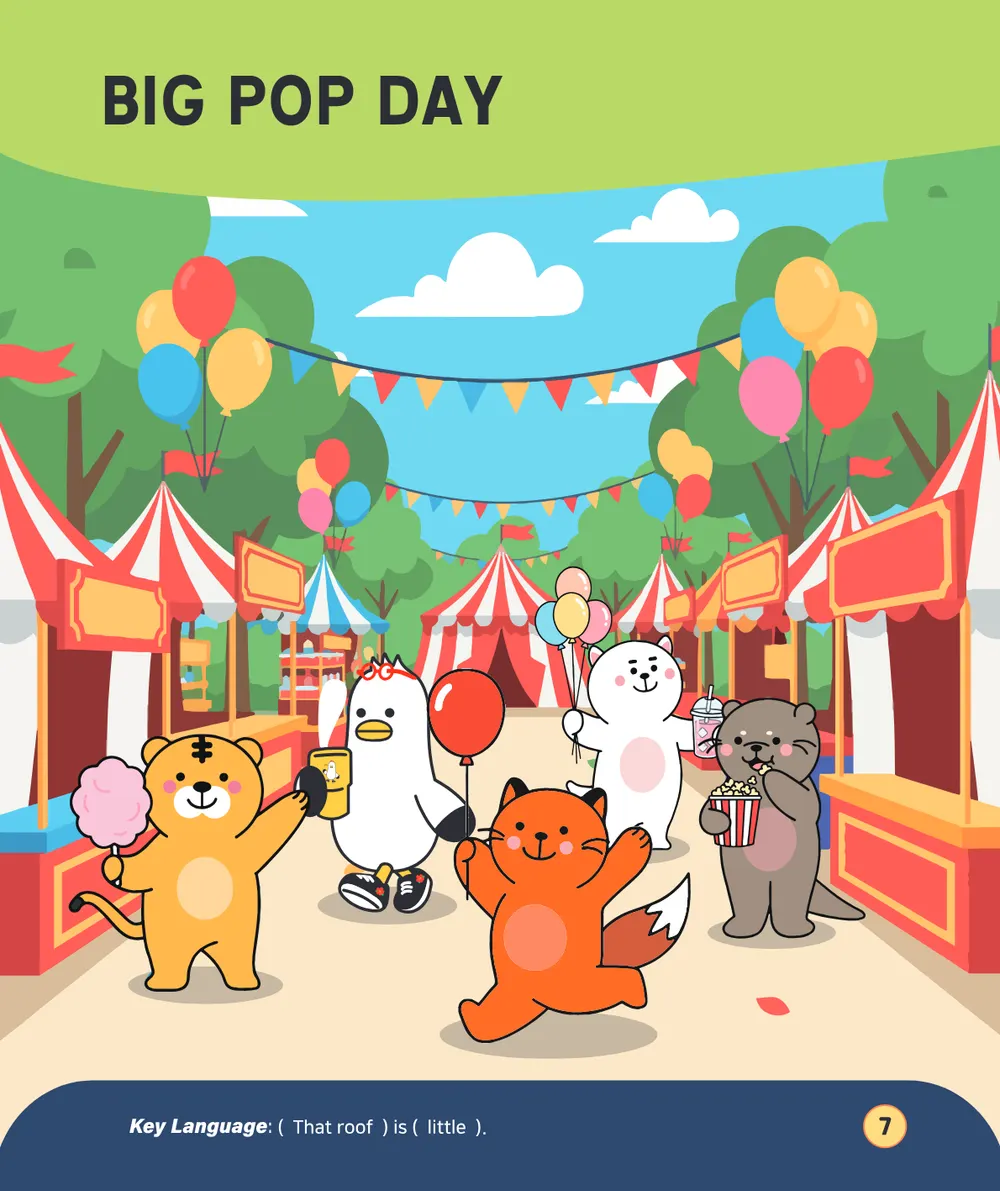
Big POP Day
(That roof) is (little).
 LESSON 2
LET’S GET STARTED
Story Review and Skills
Follow the shared lesson flow, with room to repeat, pause and play.
Start presentation Slides, audio and teaching notes in one place.Your lesson flow
Week 1 · Day 2- 01Routine
Hello & warm-up
Greetings, feelings, weather and the day.
- 02SB
story time; review the story in full & check comprehension
Student Book · p. 10–25
- 03SB
skills
Student Book · p. 26
- 04WB
story
Workbook · p. 5–6
SING · MOVE · PLAY
A little more play
Built into your lesson. Repeat or skip to suit your class; keep time for the book and conversation.
More official songs & online games
Preview external pages before class. They open in a new tab and may need internet or show provider content.
- Walking Walking · movement song ↗Use before seated book work. Model actions in place.
- Starfall ABCs · letter exploration ↗Choose the lesson’s letter with your class. Best after introducing its sound.
- British Council · word games ↗Select the topic first; reading tasks need teacher help for beginners.
Our games add oral practice to the curriculum. They do not measure a child’s English level.
Teaching guide
Original Teacher’s Guide. Each 40-minute lesson covers two guide periods.
2. Story Review and Skills
W1 P3Read Together 2 + Story Review
Lesson Goals
- To read and understand the story
- To review size vocabulary
Students will be able to
- Identify and describe size changes in the story
- Answer simple comprehension questions about the story
- Create a movie poster and say a key line from the story
1. Warm-Up
Hello Song · “How are you?” · “How’s the weather today?” · Day of the week check
2. Vocabulary Review (Student Book pg 8)
- Review target vocabulary through actions and explanations.
3. Story time (Student Book pg 20-25)
- a) Story Review (pg 10-19). Guide the review by pointing to key story scenes and asking students to name the shapes they see in each picture. Model the target language first, then invite students to respond together or individually. “Where are they?” “What did our friends eat?” “What happened to them?” “How big are they?” “Are they huge?”
- b) Read together (pg 20-25).
- i) pg 20-21 — “Oh! Look at Hoggy’s nose! Something is going inside.” “What is it? Is it a bird? Is it a bee?”
- ii) pg 22-23 — find out why our friend changed sizes. Try to elicit an answer and help them make the connection if they can’t do it on their own. “Now look at Hoggy. What happened to him?” “Is he tall?”
- iii) pg 24-25 — look at the pictures of Hoggy and his friends and talk about the size adventure he went on. “Who is small?” “Look at the popcorn bucket again. What does it say? It says ‘Very Interesting Popcorn’! Hmm, what does that mean?” Allow them to engage as a whole so they don’t feel pressured to speak.
- d) Read the story again and ask students comprehension questions.
4. Activity — My Movie Poster
- Objective: students create a movie poster based on their favorite scene. They illustrate the scene and include the original title and a key line of dialogue from the story.
- Materials: A4 size paper; markers, crayons, colored pencils.
- a) Pick one scene that students liked the most today.
- b) Draw what happened in that scene.
- c) Copy the actual dialogue from that scene to use as a “catchphrase” or subtitle.
5. Wrap-up
- Review target words with the Let’s Chant song, then finish the class with the Goodbye song.
W1 P4Workbook (Story) + Student Book (Skills)
Lesson Goals
- To review the story
- To understand and compare sizes
Students will be able to
- Match sentences to pictures and sequence the story
- Identify and use size words
- Compare characters and call out the correct size
1. Warm-Up
Hello Song · “How are you?” · “How’s the weather today?” · Day of the week check
2. Workbook pg 5 — Story
- Guide students to read each sentence aloud and choose the right picture that matches the sentence. Read the sentences together and interact enthusiastically to get them to choose the correct option.
3. Workbook pg 6 — Story
- Ask students to recall the story and instruct them to write the correct numbers (1 to 4) in the boxes to show the proper order, then direct them to color the illustrations.
- “Look at the four pictures in your workbook. They are not in the right order!” “First, let’s write numbers 1, 2, 3 and 4 to show the correct sequence.” “Once you’ve finished numbering, you can start coloring the scenes to make your story look wonderful.”
4. Skills — Numbers: Size
- Guide students to distinguish between different sizes and heights by providing verbal instructions for each picture.
- Direct students to the four boxes on page 26 and explain that they will color only one object in each box. Example — Box 1: point to the trees and instruct students to find and color the tall one.
5. Activity — Character Size Guessing Game
- Objective: students identify and call out the correct size adjectives.
- a) Show a photo of Character A and ask “Is he/she big or small?” Then show a photo of Character B and ask the same question.
- b) Ask the students to predict the outcome: “Who is bigger? Make a guess!”
- c) The reveal (visual proof): present the comparison photo where both characters stand together at their actual sizes. Lead the class in confirming the result: “Look! Character A is bigger!”
- Teacher Tip: use famous characters that are highly popular among children to maximize engagement. Romi vs. Hachuping; Pobi vs. Pororo; Ant-Man vs. Hulk.
5. Wrap-up
- Review target words with the Let’s Chant song, then finish the class with the Goodbye song.