
Boogi Station / UNIT 07 BG07
High Five Senses
I (see) a (coin).
 LESSON 1
LET’S GET STARTED
Words and Story
Follow the shared lesson flow, with room to repeat, pause and play.
Start presentation Slides, audio and teaching notes in one place.Your lesson flow
Week 1 · Day 1- 01Routine
Hello & warm-up
Greetings, feelings, weather and the day.
- 02SB
introduce characters
Student Book · p. 4–5
- 03SB
unit introduction
Student Book · p. 7
- 04SB
vocab introduction
Student Book · p. 8
- 05SB
chant
Student Book · p. 9
- 06SB
story time
Student Book · p. 10–23
- 07WB
words
Workbook · p. 4–5
SING · MOVE · PLAY
A little more play
Built into your lesson. Repeat or skip to suit your class; keep time for the book and conversation.
More official songs & online games
Preview external pages before class. They open in a new tab and may need internet or show provider content.
- Walking Walking · movement song ↗Use before seated book work. Model actions in place.
- Starfall ABCs · letter exploration ↗Choose the lesson’s letter with your class. Best after introducing its sound.
- British Council · word games ↗Select the topic first; reading tasks need teacher help for beginners.
Our games add oral practice to the curriculum. They do not measure a child’s English level.
Teaching guide
Original Teacher’s Guide. Each 40-minute lesson covers two guide periods.
1. Words and Story
W1 P1Intro to class theme + Vocabulary — Student Book (Words)
Lesson Goals
- To introduce the unit theme and learn the target vocabulary
- To encourage students to respond to English with actions and simple words
Students will be able to
- Identify the sensory words
- Show the correct gesture when the teacher says a sensory word
1. Warm-Up
Hello Song · “How are you?” · “How’s the weather today?” · Day of the week check
2. Introduce Characters (Student Book pg 4-5)
- a) Name & Identification. Point to each character and say the name clearly. “This is Boogi. Everyone say, ‘Hello, Boogi!’” “This is Otto. Can you say, ‘Hi, Otto’?” “This is Hoggy. Everyone, ‘Hoggy!’” Review: point to a random character and ask, “Who is this?”
- b) Engaging with Character Stories. “Who is the leader of the team?” (Boogi!) “Who likes to surf?” (Otto!) “Who is a food YouTuber?” (Hoggy!) “Who is Jindo looking for?” (Her owner!) “Tigo has a big imagination! What is he searching for?” (A mystery creature!)
- c) Personal Connection. “Which character is the coolest?” or “Who do you want to play with?”
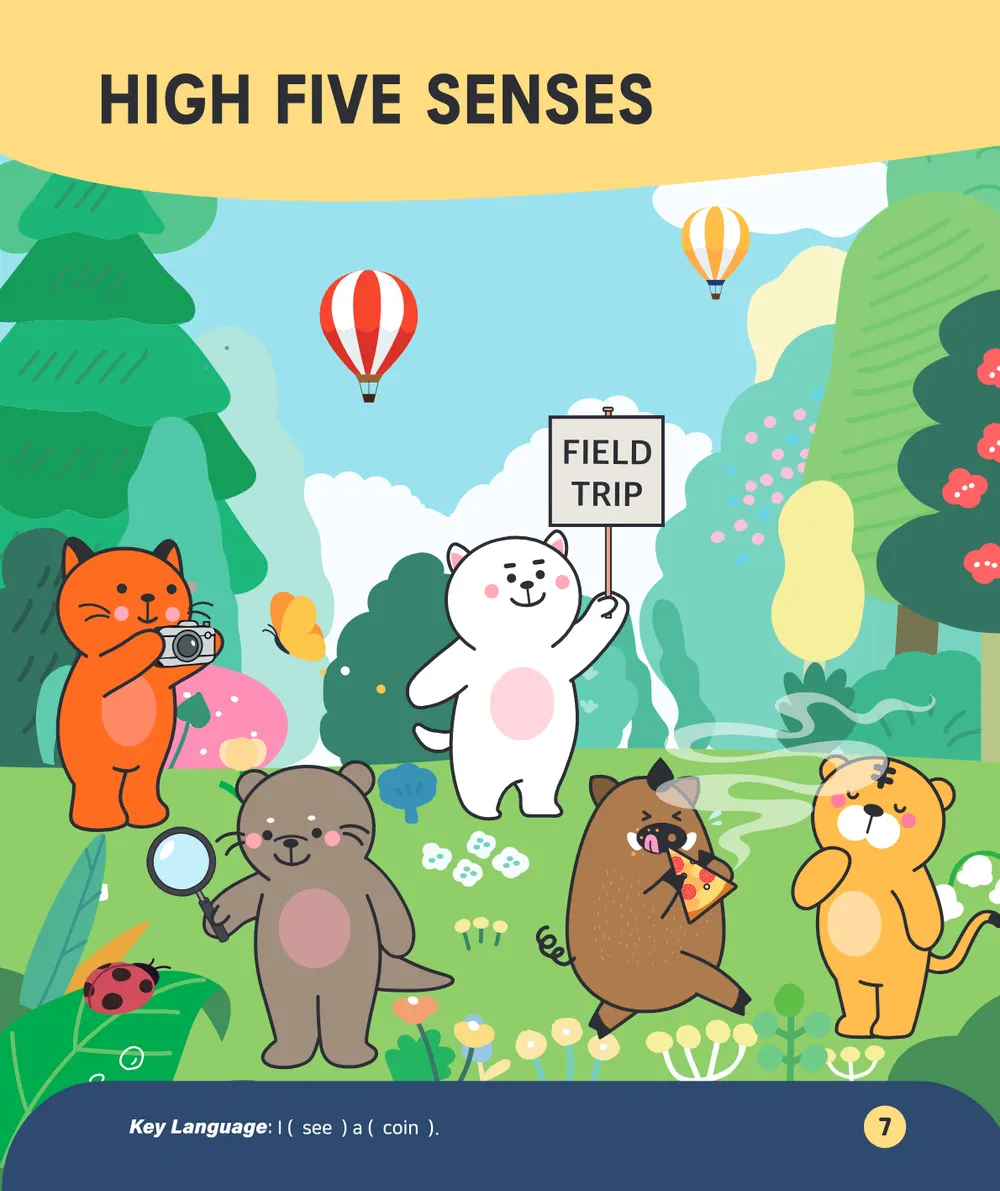
3. Previous Unit Review & New Unit Introduction (Student Book pg 7)
- a) Review the previous unit (Shapes). Review circle, triangle, square, heart, shapes from the picture. “Look at the picture. What shapes do you see?” “Do you see a circle?” (Point to the magnifying glass) “What shape is the sign?” “Can you find a triangle?” “Good! We know shapes!”
- b) Introduce the New Unit Theme (Senses). Shift students’ attention from shapes to how we experience the world, using the same picture. “Look at Otto.” “What is Otto holding?” “He is seeing flowers and bugs.” “What is Hoggy doing?” “He is smelling pizza.” “Look at Tigo.” “Is he listening?” “What can you hear on a field trip?” “We use our five senses.” “See, hear, smell, touch, taste.”
4. Introduction to vocabulary (Student Book pg 8)
- a) Introduction. Clearly pronounce the target words — see, hear, smell, touch, taste — and have students repeat.
- b) Physical Demonstration. See: make binoculars with both hands, or place a hand above the eyes and pretend to look far away. Hear: cup a hand behind the ear and tilt the head slightly as if listening carefully. Taste: pretend to eat food (e.g. pizza) and show a tasting reaction. Smell: pretend to sniff a flower slowly and react to the smell. Touch: gently touch an object or pretend to touch something soft (e.g. a cat).
- Repeat the action once more while saying a short model sentence: “I see a tree.” “I hear a bird.” “I taste pizza.” “I smell a flower.” “I touch a cat.”
- c) Comprehension Check. Check understanding using thumbs up / thumbs down. Say a sense word and show a gesture or point to a body part. Say “See.” and point to the eyes → thumbs up. Say “Hear.” and point to the mouth → thumbs down.
- d) Personal Connection. “Do you like the smell of flowers?” “What sense do you use for music?” “What sense do you use to feel?”
- e) Point & Repeat (pg 8). Point to each picture. Say slowly: “See. See. Repeat after me.” Students repeat in chorus, then individually.
- f) Circle & Say (pg 8). Teacher models: circle ‘see’ on the page → say “I see.” Students take turns circling a word and saying it out loud.
5. Activity (Vocabulary) — Sense Statues
- a) Have students walk or dance in place while the teacher claps or plays music.
- b) The teacher suddenly stops and shouts a sense word (e.g. “Smell!”).
- c) Students must freeze in a pose related to that sense (e.g. sniffing a flower).
- d) Repeat with other words: see (binoculars), hear (cupping ears), taste (licking), touch (feeling the floor).
- e) Praise students who freeze quickly and correctly.
6. Let’s Chant (Student Book pg 9)
- “Now, we’re going to sing a song about sense! Listen carefully!” Play the song. Pause after each sentence and have students repeat the words. Play the song again for fun — faster or slower so that students can enjoy it.
- Teacher Tip: use this chant repeatedly throughout the unit whenever students need a quick energy boost, transition, or mood change.
6. Wrap-up
- Finish the class with the Goodbye song.
W1 P2Read Together + Workbook (Words)
Lesson Goals
- To review and reinforce target vocabulary
- To read a story together
- To support understanding through pictures and repeated language
Students will be able to
- Recognize and name the five senses: see, hear, smell, touch and taste
- Identify which sense Roo is using in different story scenes
- Practice identifying and reinforcing sense words by completing workbook activities
1. Warm-Up
Hello Song · “How are you?” · “How’s the weather today?” · Day of the week check
2. Vocabulary review (Student Book pg 8)
- Review target vocabulary through actions and explanations.
3. Workbook pg 4 — Words
- Guide students to match each sensory word (see, hear, smell, touch, taste) to the corresponding body part of Roo.
4. Workbook pg 5 — Words
- Direct students to look at each picture and identify which sense we use to experience the object.
5. Story Time (Student Book pg 10-23)
- a) Character Introduction. “Today, we’re going to read a fun story about our five senses! Let’s meet the characters!” Introduce Roo and Roo’s mom, using pictures or puppets if available.
- Note for the teacher: skip the traditional picture walk for this lesson to keep students engaged with Roo’s perspective without spoiling the story.
- b) Read together. Read the story aloud one page at a time, slowly and clearly, pausing after each sentence or short phrase. Focus on a different sense for each spread, encouraging students to predict the story through sensory imagination before revealing the content.
- i) pg 10–11 — guide students to observe the room. “Look at the room. How is it? Is it clean?” “Where is the bag?” “What else do you see?” Introduce the mission to build anticipation: “Roo will use her eyes, nose and ears to clean her room. How? Let’s find out.”
- ii) pg 12–13 (see) — model the sentence “I see…” and lead a choral reading. Show a small clue on page 12, ask a simple question (“What is this?” “It is shiny”), then move to page 13 to identify and read the word ‘a coin’ together.
- iii) pg 14–15 (hear) — model “I hear…” and lead a choral reading. Show a small clue on page 14 (a box making a rattle sound), ask “What is in the box?”, then move to page 15 to read ‘a block!’ together.
- iv) pg 16–17 (smell) — model “I smell…” and lead a choral reading. Show a small clue on page 16 (smelly lines coming from the bookshelf), ask “What is that smell?”, then move to page 17 to read ‘a sock!’ together.
- v) pg 18–19 (touch) — model “I touch…” and lead a choral reading. Show a small clue on page 18 (something fuzzy inside the backpack), ask “What is inside the bag?”, then move to page 19 to read ‘a teddy bear!’ together.
- vi) pg 20-23 (taste and end) — continue reading the rest of the book through to page 23 to finish the story, with the teacher modeling each line slowly and the students following in a choral reading.
- c) Read the story again and have students repeat after the teacher.
6. Connecting to Students’ Lives & Comprehension
- Relate the story to the students’ experiences: “Do you smell your food?” “Can you see things like your phone?” “What can you touch in this room?”
7. Wrap-up
- Review target words with the [Let’s Chant] song, then finish the class with the Goodbye song.