
Boogi Station / UNIT 07 BG07
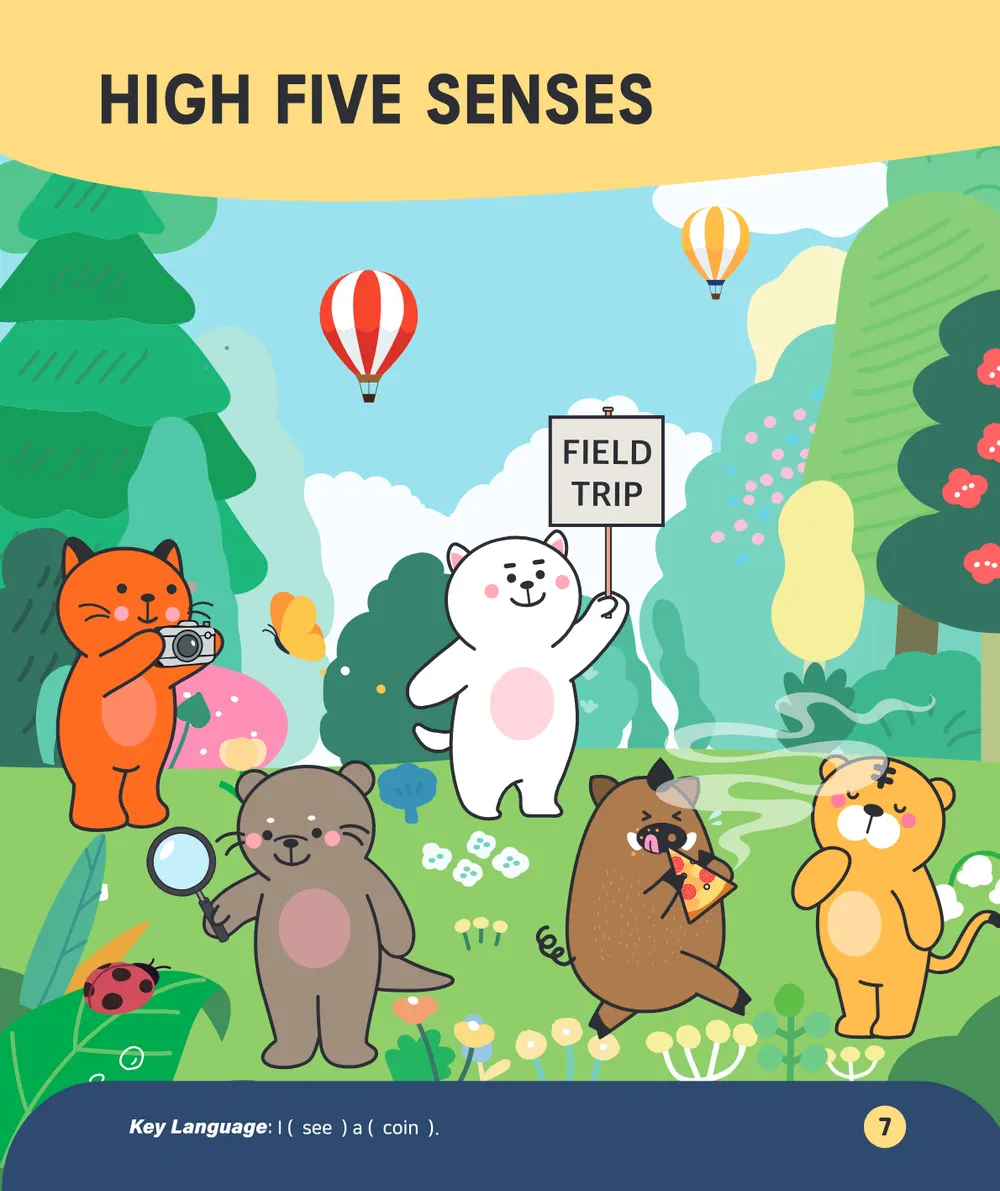
High Five Senses
I (see) a (coin).
 LESSON 3
LET’S GET STARTED
CLIL and Phonics
Follow the shared lesson flow, with room to repeat, pause and play.
Start presentation Slides, audio and teaching notes in one place.Your lesson flow
Week 2 · Day 1- 01Routine
Hello & warm-up
Greetings, feelings, weather and the day.
- 02SB
story review, brief
Student Book · p. 10–23
- 03SB
CLIL, Mystery Bag
Student Book · p. 25
- 04WB
phonics
Workbook · p. 8–9
SING · MOVE · PLAY
A little more play
Built into your lesson. Repeat or skip to suit your class; keep time for the book and conversation.
More official songs & online games
Preview external pages before class. They open in a new tab and may need internet or show provider content.
- Walking Walking · movement song ↗Use before seated book work. Model actions in place.
- Starfall ABCs · letter exploration ↗Choose the lesson’s letter with your class. Best after introducing its sound.
- British Council · word games ↗Select the topic first; reading tasks need teacher help for beginners.
Our games add oral practice to the curriculum. They do not measure a child’s English level.
Teaching guide
Original Teacher’s Guide. Each 40-minute lesson covers two guide periods.
3. CLIL and Phonics
W2 P1Student Book — Read together review + Student Book (CLIL)
Lesson Goals
- To review the story and key ideas
- To explore the five senses through activities
- To encourage participation in English
Students will be able to
- Answer simple questions about the story
- Identify senses and related objects
- Describe objects using sensory words
1. Warm-Up
Hello Song · “How are you?” · “How’s the weather today?” · Day of the week check
2. Story Review (Student Book pg 10–23)
- Quickly flip through pages 10-23, pointing to the pictures. Ask key questions about the story, pausing after each to allow students time to answer: “What sense is Roo using here?” (touch) “What is Roo smelling?” “What can Roo see?”
3. CLIL — Mystery Bag (Student Book pg 25)
- Objective: students identify hidden objects by using their five senses and describing sensory characteristics.
- Materials: a small bag, sensory cards (hear, smell, taste, touch), safe objects for each sense. Hear: rattle, bell, small instrument. Smell: orange peel, coffee beans, soap. Taste: small candy, cracker (teacher-guided, allergy-safe!). Touch: teddy bear, sock, block.
- a) Show the bag and ask warm-up questions: “What do you think is in the mystery bag?” “Let’s use our senses!” “Which sense can help us first? Touch? Smell? Hearing?”
- b) A student comes forward and picks one sense card from a pile.
- c) Secretly put an object that matches that sense into the bag.
- d) The student performs the action according to the card. Help the student say the sentence if needed: “I feel… It’s round!” “I hear… It’s loud!” “I smell… It’s sweet!”
- e) Ask the class “What do you think it is?” and students guess the object.
- f) Reveal the object: “Yes! It’s a (teddy bear)!”
- g) Repeat with other students and different sense cards.
4. Wrap-up
- Review target words with the [Let’s Chant] song, then finish the class with the Goodbye song.
W2 P2Phonics (Workbook)
Lesson Goals
- To introduce the phonics sound O o
- To support early phonics awareness through listening and speaking activities
- To reinforce phonics learning using familiar vocabulary and visuals
Students will be able to
- Identify the sound /ɑ/ for O o
- Recognize words that begin with O o from pictures
1. Warm-Up
Hello Song · “How are you?” · “How’s the weather today?” · Day of the week check
2. Phonics Introduction — O o
- a) Demonstrate pronunciation. Write uppercase “O” and lowercase “o” on the board. “The letter O makes the /ɑ/ sound.” “To make the /o/ sound, open your mouth wide like a big circle. Imagine you are saying ‘Ah!’ at the doctor’s office.” “Let’s make the sound together: /ɑ/, /ɑ/, /ɑ/!” Exaggerate the sound.
- b) Direct students to the pictures on workbook page 8. “/ɑ/, /ɑ/, /ɑ/ like in orange, /ɑ/, /ɑ/, /ɑ/ like in ox, /ɑ/, /ɑ/, /ɑ/ like in octopus.”
- Orange — pretend to hold a round orange, peel it and eat a piece, then make a sour face (squint your eyes!) and say “Orange!” Ox — put your pointer fingers on the sides of your head like horns and say “Ox!” Octopus — wiggle your fingers and arms like eight wiggly legs and say “Octopus!” Encourage students to copy your actions.
- c) Practice saying these words numerous times. If some students have difficulty with a certain aspect of pronunciation, focus on that again and again until it is understood.
3. Workbook pg 8 — Phonics
- “Now, let’s look at page 8. It’s a big orange tree! But some oranges are missing.” Point out the missing oranges and direct students to the sticker page. “Let’s go to the sticker page and find the Letter Oo, orange, ox and octopus stickers.”
- As students place the stickers on the gray circles, point to each image and model the sound with exaggeration, encouraging students to repeat: “Put the stickers on the gray circles and say /ɑ/, /ɑ/, /ɑ/!”
- Finally, lead the students to repeat all the O words one last time to finish the activity.
4. Workbook pg 8 — Letter O Octopus
- “Look at the big letter O! It wants to be an octopus. Let’s help it!” Direct students to find the stickers to decorate the letter O. “Go to the sticker page and find the eyes, mouth and tentacles (legs) stickers. Let’s put them on the big O!”
- As students complete the octopus, practice the /o/ sound and the word: “Now it’s a wiggly octopus! Say the sound with me: /ɑ/, /ɑ/ octopus!”
- Finally, have the students repeat the letter name and the word together: “What letter is this? It’s Letter O! O is for octopus!” If time allows, have the students color the Oo at the bottom.
5. Activity (Phonics) — Hungry Octopus
- Objective: students identify words starting with the /ɑ/ sound and use body movements to demonstrate their understanding of the letter ‘O’ phonics.
- a) Have students stand up and make a big ‘O’ with their arms. “Everyone, stand up! Let’s make a big Letter O with our arms over our heads. This is our Hungry Octopus mouth!”
- b) Explain that the octopus only eats words starting with the /ɑ/ sound. “The Octopus is very hungry! But it only eats snacks that start with /ɑ/, /ɑ/, /ɑ/. Listen carefully!”
- c) Call out different words. For O words: students eat the word by moving their O-arms and saying “/ɑ/, /ɑ/, /ɑ/!” For non-O words (from previous units): students must close their mouths (arms).
- d) Lead the students to rub their bellies and repeat the sound. “Now the Octopus is full! Let’s say it one last time: /ɑ/, /ɑ/, /ɑ/! Great job, everyone!”
6. Wrap-up
- Review target words with the [Let’s Chant] song, then finish the class with the Goodbye song.