
Roo Station / UNIT 01 RO01
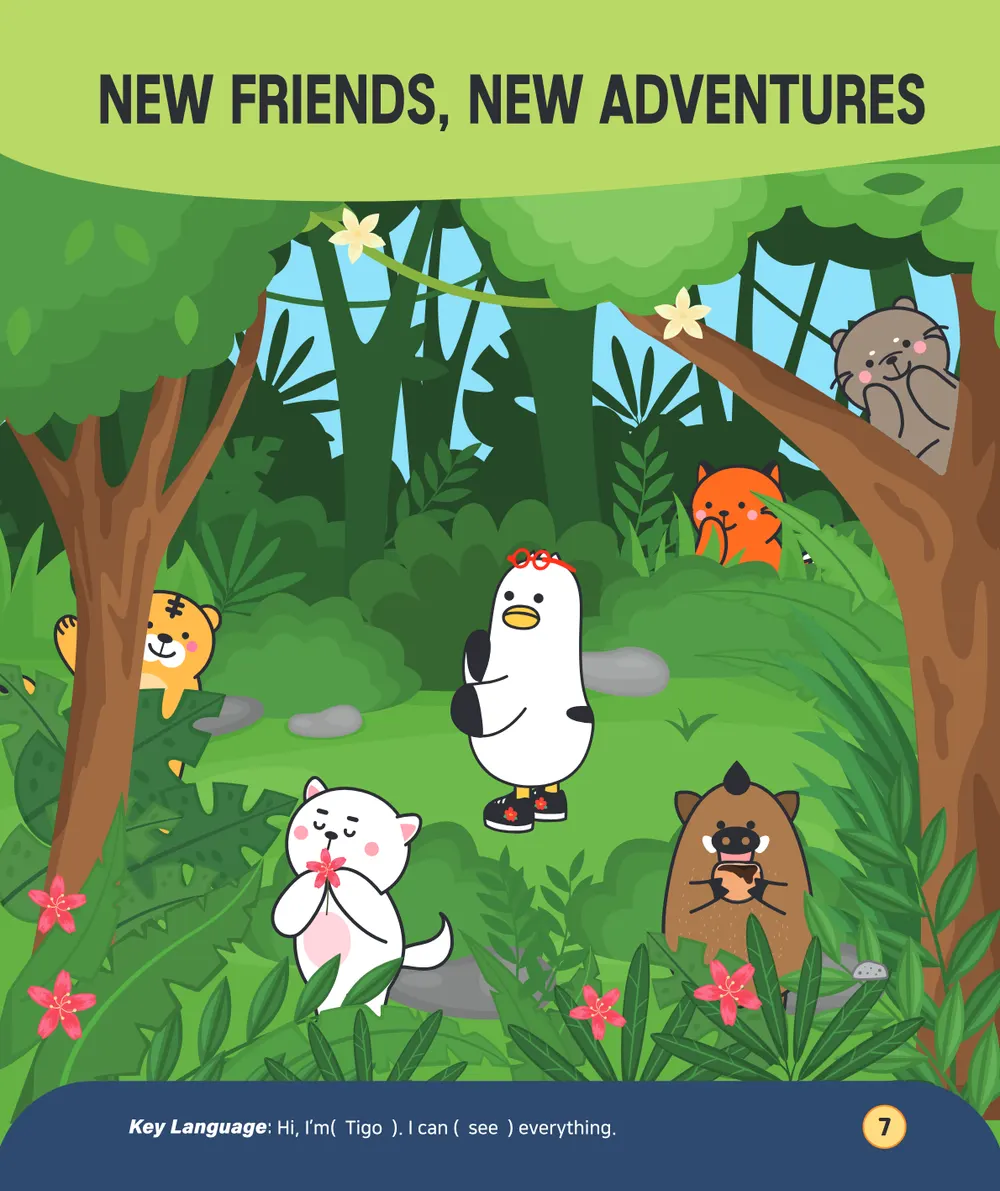
New Friends, New Adventures
Hi, I'm (Tigo).
 LESSON 3
LET’S GET STARTED
CLIL and Phonics
Follow the shared lesson flow, with room to repeat, pause and play.
Start presentation Slides, audio and teaching notes in one place.Your lesson flow
Week 2 · Day 1- 01Routine
Hello & warm-up
Greetings, feelings, weather and the day.
- 02SB
story review, brief
Student Book · p. 10–25
- 03Optional
mystery box
Student Book · p. 27
- 04WB
phonics
Workbook · p. 7–8
SING · MOVE · PLAY
A little more play
Built into your lesson. Repeat or skip to suit your class; keep time for the book and conversation.
More official songs & online games
Preview external pages before class. They open in a new tab and may need internet or show provider content.
- Walking Walking · movement song ↗Use before seated book work. Model actions in place.
- Starfall ABCs · letter exploration ↗Choose the lesson’s letter with your class. Best after introducing its sound.
- British Council · word games ↗Select the topic first; reading tasks need teacher help for beginners.
Our games add oral practice to the curriculum. They do not measure a child’s English level.
Teaching guide
Original Teacher’s Guide. Each 40-minute lesson covers two guide periods.
3. CLIL and Phonics
W2 P1Student Book read together review + Student Book (CLIL)
Lesson Goals
- To reinforce students’ understanding of the story New Friends, New Adventures by reviewing characters, settings, and key ideas through guided questioning and visuals
- To develop students’ speaking confidence by using familiar daily expressions related to feelings, weather, and days of the week
Students will be able to
- Recall and answer key story questions (characters, clues, 5 senses) using simple English with visual support
- Respond accurately to routine warm-up questions using complete phrases
- Play “Mystery Box: 5 Senses”, practising using their senses to identify mystery items in a box
1. Warm-Up
Hello Song · “How are you?” · “How’s the weather today?” · Day of the week check
2. Brief Story Review (Student Book pg 10-25)
- Say: “Let’s quickly remember our ‘New Friends, New Adventures!’” Open Student Book to page 10. Quickly flip through pages 10-25, pointing to the pictures.
- Key Question Q&A: “Where did the friends go?” (Elicit “the baseball stadium”.) “What can Tigo see? What does Tigo see with?” (Elicit “Everything / His eyes”.) “What does Otto find?” (Elicit “Boogi’s shoes!”)
3. Mystery Box: 5 Senses
- Safe objects/toys for each sense — SEE: picture card, colourful ball, shiny object. HEAR: rattle, bell, small instrument. SMELL: orange peel, coffee beans, soap. TASTE: small candy, cracker (teacher-guided, allergy-safe!). TOUCH: teddy bear, sock, block.
- Begin by reviewing the vocabulary: “What can your nose do? What can your mouth do?” → see, hear, smell, taste, touch
- b) Show the students the box and say, “What’s inside? Let’s use our senses!”
- c) Each student picks one sense at a time. TOUCH: student puts hand inside → “I touch… It’s soft!” HEAR: teacher shakes an object inside → “I hear… It’s loud!” SMELL: student puts their nose near the hole → “I smell… It’s fruity!” SEE: teacher shows a hidden picture card from the box → “I see… It’s red!” TASTE: teacher gives a small candy (optional & safe) → “I taste… It’s sweet!”
- d) The class guesses: “Is it a teddy bear?” “Is it an orange?”
- e) Reveal the object and celebrate together: “Yes! You’re right!” “Good job! You have a good sense of smell.”
W2 P2Phonics (Workbook)
Lesson Goals
- Students will recognize and differentiate between the consonant letter sounds of /s/, /n/ and /m/, as well as their combination sounds /sn/ and /sm/
- Students will understand and correctly pronounce vocabulary words (snack, smile, snow) associated with the phonics pattern s+n and s+m
- Students will connect phonics and new vocabulary in an engaging and active format
Students will be able to
- Identify the letters S, N and M, and explain that “s+n” makes a /sn/ sound in words and “s+m” makes a /sm/ sound
- Accurately pronounce and act out the target vocabulary words smell, snake, and small with correct consonant sound combinations
1. Warm-Up
Hello Song · “How are you?” · “How’s the weather today?” · Day of the week check
1. Introduce the Letters: Workbook pg 7
- c) Model, and have the students repeat so they recognize the letters. Say each sound clearly: “S says /s/, N says /n/, and s + n says /sn/.” Have students repeat several times, using hand gestures to show short and long sounds.
2. Demonstrate Pronunciation
- a) For the “S” sound: “Your mouth is open a little and your tongue is touching your front teeth gently — /s/.” Say: “/s/ like in sun, /s/ like in see, /s/ like in sad.” Practice these words several times, focusing on correct mouth shape and sound.
- b) For the “s+n” sound: “When we put s and n together, they make a hissing /sn/ sound — like in snake!” “Snakes make a hissing noise and say /sn/ — snake!” Say: “/sn/ like in snack, /sn/ like in snake, /sn/ like in snow.” Have students repeat several times, exaggerating the sound.
3. Vocabulary Practice and Actions
- Snack — pretend to hold a bag of chips and take one out at a time and eat them. “Mmm, this SNACK is so yummy!”
- Snake — put your hands together and move them in a wave motion. “What sound does a snake make? HISS!”
- Snow — pretend to catch snowflakes in your hands. “Snow, snow, come and play!”
- Encourage students to copy your actions as you demonstrate.
4. Connect Vocabulary to Students’ Lives
- For snack: “What snacks do you like to eat? Do you like sweet or salty snacks?” For snake: “Do you like snakes? Are snakes scary or cute?” For snow: “Is snow cold? What can you do in the snow?”
- Encourage short answers and gestures.
5. Sticker Activity with Match & Write
- a) Have the students go to their sticker page in their Workbooks and place the “S” and “N” stickers on pg. 7, and practice their /sn/ sound.
- b) Have the students then practice unscrambling the letters in the following exercise.
6. The “s+m” sound
- “When we put s and m together, they make a short hissing and long Mmm /sm/ sound — like in smell!” Say: “/sm/ like in smell, /sm/ like in smile, /sm/ like in small.” Have students repeat several times, exaggerating the sound.
- Smell — pretend to be smelling flowers. “Mmm, this flower SMELLS so nice!”
- SMILE — take your hand and swipe it up your face to reveal a big smile. Then swipe it down to reveal no smile. “What does your smile look like?”
- SMALL — crouch down and curl into a ball. Then jump up and expand your chest and raise your arms. “Now I am small. / Now I am big!”
- For small: “What is something small? Can you make yourself look small?”
7. Sticker Activity and Find & Circle
- c) Have the students place the “S” and “M” stickers on pg. 8 and practice their /sm/ sound.
- d) Have the students then find and circle things to “SMELL” in the following exercise.
8. Phonics action game
- a) Review the words: have cue cards of the phonics word and its correlating image for /sn/ and /sm/. Display the card but have the second letter covered with a post-it (e.g. S_AKE with an image of a snake). Have the kids guess and practice saying /n/ and /m/, then /sn/ and /sm/, then the full word.
- Ask the kids to mime the words: SNACK — eating motion. SMELL — sniffing action. SNAKE — pretend to move like a snake or hiss like one.
- b) There will be images and words hung up all around the room. Students rush to a word or image related to the sound they heard. Ideally no two students should share an image/word, to increase excitement and movement. Do several rounds.
- Make it harder: remove an image/word each round so there are fewer available spots. If they cannot find an open spot, or go to an incorrect word/image, they are out. Much like musical chairs, but with phonics.
9. Wrap-up
- Finish the class with the See You Later Alligator Song.