
Roo Station / UNIT 08 RO08
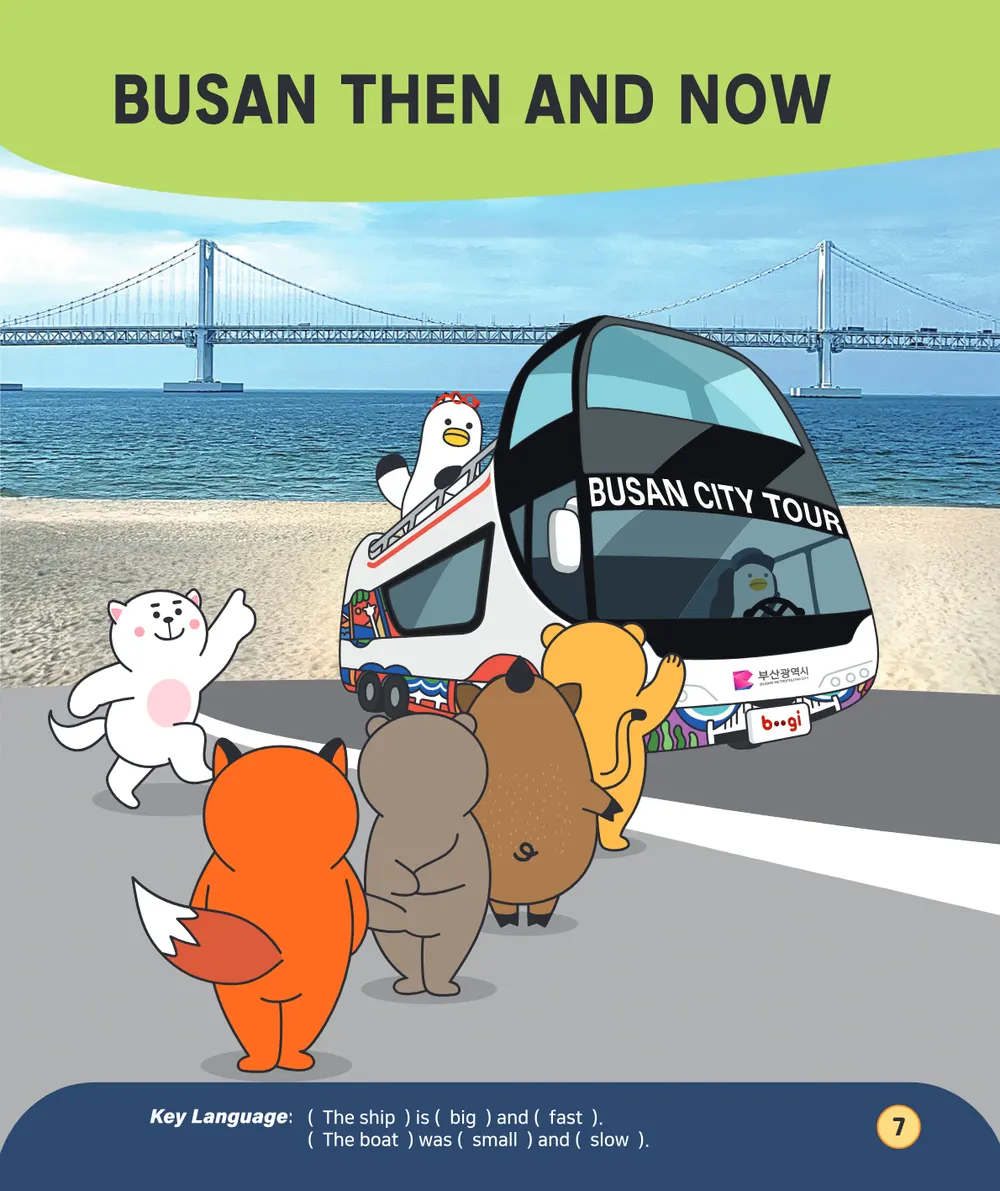
Busan Then and Now
(The ship) is (big) and (fast).
 LESSON 2
LET’S GET STARTED
Story Review and Skills
Follow the shared lesson flow, with room to repeat, pause and play.
Start presentation Slides, audio and teaching notes in one place.Your lesson flow
Week 1 · Day 2- 01Routine
Hello & warm-up
Greetings, feelings, weather and the day.
- 02SB
story time; review the story in full & check comprehension
Student Book · p. 10–21
- 03SB
skills
Student Book · p. 22
- 04WB
story
Workbook · p. 5–6
SING · MOVE · PLAY
A little more play
Built into your lesson. Repeat or skip to suit your class; keep time for the book and conversation.
More official songs & online games
Preview external pages before class. They open in a new tab and may need internet or show provider content.
- Walking Walking · movement song ↗Use before seated book work. Model actions in place.
- Starfall ABCs · letter exploration ↗Choose the lesson’s letter with your class. Best after introducing its sound.
- British Council · word games ↗Select the topic first; reading tasks need teacher help for beginners.
Our games add oral practice to the curriculum. They do not measure a child’s English level.
Teaching guide
Original Teacher’s Guide. Each 40-minute lesson covers two guide periods.
2. Story Review and Skills
W1 P3Read Together 2 + Story Review
Lesson Goals
- To help students confidently participate in daily classroom routines by practicing greetings, feelings, weather and days of the week using simple and familiar English expressions
- To build students’ understanding of the story through a picture walk, focusing on comparing Busan in the past and present, and reinforcing descriptive vocabulary with real-life connections
- To encourage active engagement and comprehension by guiding students through key vocabulary, story details and meaningful follow-up activities such as review questions and reenactment
Students will be able to
- Respond to greeting, weather and day-of-the-week questions using complete sentences such as “I’m happy,” “It’s rainy,” and “It’s Tuesday”
- Identify and use the target vocabulary (colorful, gray, quiet, loud, smooth, shaky, fast, slow) by describing pictures, answering comprehension questions and completing reading prompts
- Demonstrate understanding of the story by answering simple questions about the characters, setting and events, and by participating in a group reenactment using key phrases and actions
1. Warm-Up
Hello Song · “How are you?” · “How’s the weather today?” · Day of the week check
2. Let’s chant song (Student book pg. 9)
- Sing the chant together.
3. Student book pg 8
- Review target vocabulary through actions and explanations.
4. Interactive Reading — Student Book
- Read the story aloud, one page at a time. Read slowly and clearly. Pause after each sentence or short phrase.
- pg 16-17: underline the words that speak about the house in the past. Reinforce the idea of the past again using the pictures and explain that the past is not now.
- pg 18-19: circle the words that speak about the train now. The previous prompt focused on the past; now we focus on the present. Explain again that the present is now, today, happening.
- pg 20-21: find when and where in Busan you would like to see. Ask students to share when they choose and where this is in Busan. Ask if they have been to these places before.
5. Picture Walk (Student Book page 16-21)
- Open to page 16. Before reading the text, focus on the illustrations. Go through each page (16-21), one at a time.
- For each picture, ask open-ended questions: “What do you see in this picture?” “Do you know the name of this village?” “What do the houses look like?” “What did they look like in the past?” “Were they as colourful?” “This is the station, what do you take at the station?” “Have you ever ridden this train before?” “This is what trains look like today and this is what they were like in the past — what’s the difference?”
6. Reinforce vocabulary
- pg 16: “The houses are colorful, can you tell me what colors you see?”
- pg 17: “What color were the houses in the past? They were gray. Do you remember what gray means?”
- pg 18: “The train is quiet and smooth. Have you ever been on this train before?”
- pg 19: “The train was loud and shaky in the past. Can you show me what shaky means?” (Show them physically if they don’t understand.)
- Allow them to engage as a whole so they don’t feel pressured to speak.
7. Story Review
- a) “Let’s look at the story again and remember what happened.”
- b) Open the Student Book to page 10 and go through each page until page 21.
- c) For each page, ask key questions related to the pictures and events: “Where did they find the old glass?” “Why was it special?” “Are the ships big or small? Fast or slow?” “Can you tell me the name of this village?” “What colors can you see?” “Where is the train?” “Is it smooth or shaky?”
7. Story reenactment
- Assign characters to different students (give everyone a chance) and physically act out the story. Have lots of enthusiasm and encourage the students to be enthusiastic and have fun.
8. Wrap up
- Wrap up with the Chant on Student book pg. 9.
W1 P4Workbook (Story) + Story Book (Skills)
Lesson Goals
- To strengthen students’ understanding of story content and descriptive vocabulary through workbook activities that require selecting correct answers and matching characters with their dreams
- To build students’ knowledge of the four seasons, associated months and seasonal activities through guided practice, pronunciation support and interactive sticker tasks
- To encourage active participation and physical engagement by playing a movement-based Four Corners game that reinforces vocabulary and helps students build confidence using English in a fun context
Students will be able to
- Choose correct answers in the workbook story activity and correctly match each character with their dream
- Identify and pronounce the four seasons, the months that belong to each season and common seasonal activities
- Run to the correct corner and perform the corresponding action, showing comprehension of both season names and related motions
1. Warm-Up
Hello Song · “How are you?” · “How’s the weather today?” · Day of the week check
1. WB pg 5-6 — Story activity
- a) Go to workbook page 5 and look at the sentences. Select the correct response from the students and have them circle it in their books. Read the sentences together and interact enthusiastically to get them to choose the correct option.
- b) Workbook page 6. Use the stickers provided in the book to have the students put the matching past pictures on the present pictures. Encourage individual work; when everyone is complete, go through the answers together. Review each vocabulary word as it is introduced by asking the students where the pictures are and going over the learnt adjectives.
2. Skills (Student book pg. 22)
- a) Open the student book to page 22. There is a sticker activity that focuses on the different seasons in Busan.
- b) First go over the seasons: write the 4 seasons and their months on the board and practice saying them with the students. Ask them if they know the seasons and stress the order of them. Get them to engage by asking what their favourite season is.
- c) Write some activities (skiing, having a picnic, cycling, etc.) on the board and go over them. Get everyone involved and write an activity on the board if a student gives you a new one.
- d) Practice the pronunciation of the seasons, the months and the different activities one more time. You can speed it up or slow it down to make it more fun. Be sure to check for understanding and take your time practicing until all students are comfortable.
- e) Let the students put the stickers in the correct place. Encourage them to try by themselves and then, when everyone is finished, check the answers together.
3. Seasonal Four Corners
- a) Preparation: label each corner of the room with a season — Spring, Summer, Fall/Autumn, Winter. Use pictures if possible (flower, sun, leaf, snowflake).
- b) Teach the season actions. Spring — “Smell the flowers”. Summer — “Swim”. Fall — “Catch the leaves”. Winter — “Shiver”. Practice each one.
- Variations: action only (do the action without saying the season); season only (say the season without doing the action); tricky teacher (say the season but do the wrong action).
- Student leaders: let 2–3 students be the caller. They can call “Winter!” or act like swimming, smelling flowers, etc. This boosts confidence and keeps the game exciting.
4. Wrap up
- a) Review the vocabulary practiced in the game and stickers activity. Ask questions to check for understanding.
- b) Enthusiastically wave them goodbye and say “See you next time!”