
Roo Station / UNIT 08 RO08
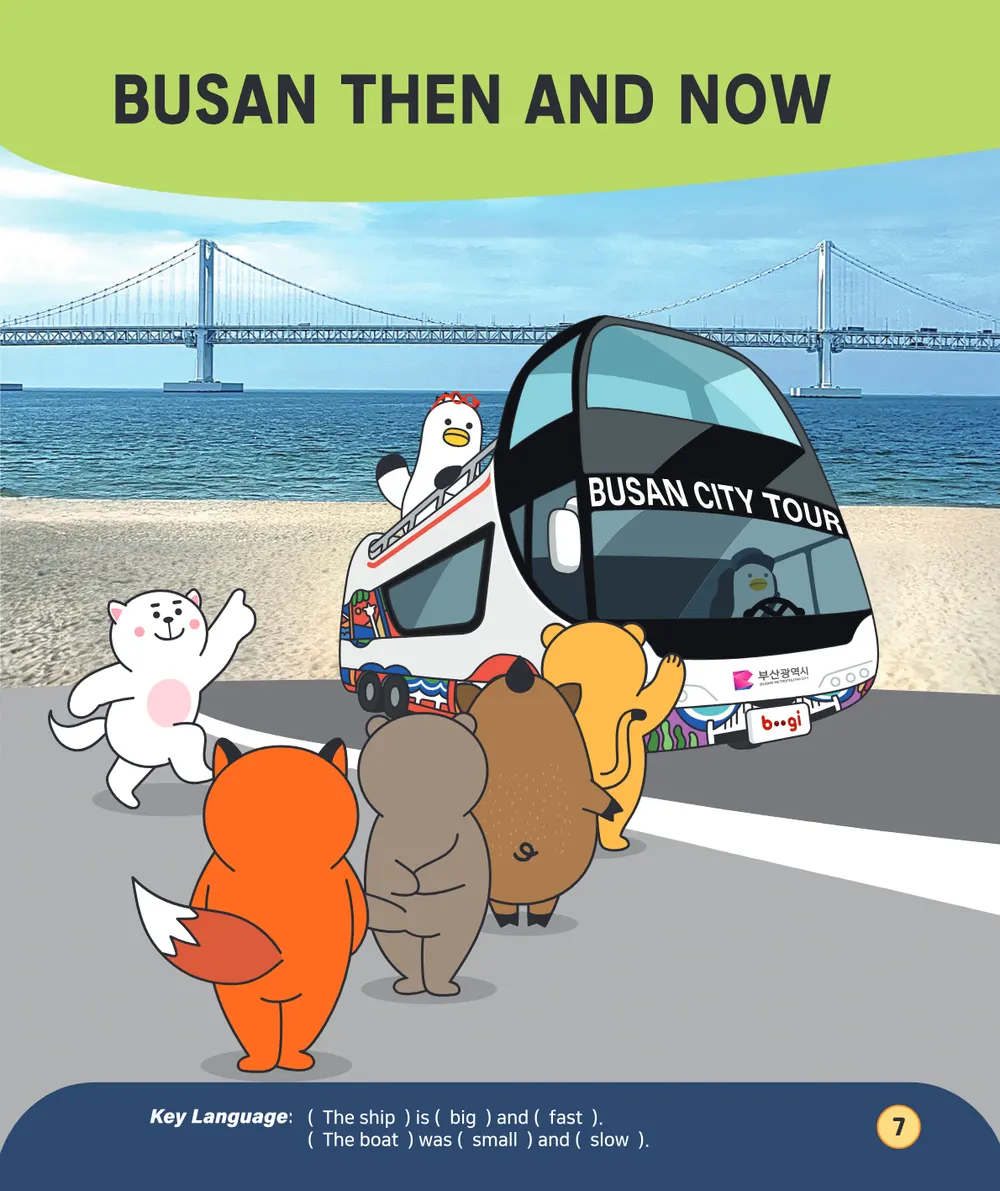
Busan Then and Now
(The ship) is (big) and (fast).
 LESSON 3
LET’S GET STARTED
CLIL and Phonics
Follow the shared lesson flow, with room to repeat, pause and play.
Start presentation Slides, audio and teaching notes in one place.Your lesson flow
Week 2 · Day 1- 01Routine
Hello & warm-up
Greetings, feelings, weather and the day.
- 02SB
story review, brief
Student Book · p. 10–21
- 03SB
CLIL, Then and now
Student Book · p. 23
- 04WB
phonics
Workbook · p. 7–8
SING · MOVE · PLAY
A little more play
Built into your lesson. Repeat or skip to suit your class; keep time for the book and conversation.
More official songs & online games
Preview external pages before class. They open in a new tab and may need internet or show provider content.
- Walking Walking · movement song ↗Use before seated book work. Model actions in place.
- Starfall ABCs · letter exploration ↗Choose the lesson’s letter with your class. Best after introducing its sound.
- British Council · word games ↗Select the topic first; reading tasks need teacher help for beginners.
Our games add oral practice to the curriculum. They do not measure a child’s English level.
Teaching guide
Original Teacher’s Guide. Each 40-minute lesson covers two guide periods.
3. CLIL and Phonics
W2 P1Student Book — Read together review + Student Book (CLIL)
Lesson Goals
- To help students confidently recall key details from the story Busan Then and Now by reviewing visuals, answering simple comprehension questions and using familiar vocabulary related to past and present
- To build students’ understanding of time concepts — past, present and future — through a CLIL activity that encourages comparison, creativity and the use of descriptive adjectives
- To promote expressive language use by guiding students to describe objects across different time periods using structured phrases and by sharing their work with partners or small groups
Students will be able to
- Answer key comprehension questions about the story by identifying characters, locations and differences between past and present scenes using simple sentences
- Describe objects using the target phrases “Then, it was…”, “Now, it is…” and “In the future, it will be…” and correctly apply adjectives such as big, small, fast, slow, colorful and gray
- Complete the “Then–Now–Future” worksheet by drawing, labeling and verbally sharing one object across three time periods
1. Warm-Up
Hello Song · “How are you?” · “How’s the weather today?” · Day of the week check
2. Brief Story Review
- “Let’s quickly remember our Busan Then And Now.” Open the Student Book to page 10 and quickly flip through pages 10-21, pointing to the pictures.
- Key questions: “Where did they find the funny looking glass?” “What is this bridge’s name?” “Where do you need to go to ride a train?” “How do the houses look now?” (emphasis on present tense) “What was the train like in the past?” (emphasis on past tense)
3. CLIL Activity (Student book page 23)
- a) Materials needed: a “Then and Now” worksheet (3 sections: Past – Present – Future); pictures of objects from the past and present (phone, car, train, house, camera, TV, bicycle, shoes); pencils, crayons, markers.
- b) Key language. Write the following on the board and go through each phrase and adjective together as a class. Focus on contextualising the difficult words by creating examples and physical actions. Key phrases: “Then, it was…” (small, slow, simple, gray, heavy…) “Now, it is…” (big, fast, colorful, light…) “In the future, it will be…” (flying, tiny, smart, invisible…) Useful adjectives: big / small, slow / fast, old / new, simple / colorful, heavy / light.
- c) How to play. Show examples: show two pictures of the same object from the past (then) and the present (now). Ask: “What is this?” “Which one is THEN?” “Which one is NOW?” “How are they different?”
- Explain the activity: students pick one object and compare Then (past) / Now (present) / Future (20 years later).
- Worksheet time: students choose an object (e.g. a phone). In the Then box → draw the old version. In the Now box → draw the current version. In the Future box → imagine and draw what it might look like 20 years later.
- Sharing time: students show their worksheets to a partner or small group and say one sentence about each — “Then, it was…” “Now, it is…” “In the future, it will be…”
- Wrap-up: display some creative examples on the wall as a “Then–Now–Future Gallery”.
4. Finish the class
- Finish with the chant in Student book pg. 9.
W2 P2Phonics (Workbook)
Lesson Goals
- To help students understand the difference between short O, short E and long O (magic E) sounds through clear modeling, repetition and physical gestures that support pronunciation
- To build students’ confidence in reading and recognizing long O (o_e) words by practicing vocabulary such as hope, code and note through actions, workbook activities and guided decoding
- To encourage students to apply phonics knowledge in a fun and active way by sorting words into short O and long O categories during a movement-based game
Students will be able to
- Identify and correctly pronounce short O (/ŏ/), short E (/ĕ/) and long O (/oʊ/) by repeating modeled sounds and completing gestures that match each vowel sound
- Decode and read o_e words by adding the magic E, recognizing how it changes the vowel sound, and completing workbook tasks that involve sticking, circling and writing the correct long O words
- Categorize phonics words by sound pattern during the sorting game
1. Warm-Up
Hello Song · “How are you?” · “How’s the weather today?” · Day of the week check
1. Introduce the Letters
- b) Write “o_e” with a blank space between O and E (like o__e) and underline it.
- c) Explain: “Sometimes we add a magic E at the end of a word. Magic E is silent, but it makes the O say its name — /oʊ/. So O + Magic E makes the long O sound.” Example: home, code, note.
- d) Model the sounds: O says /ŏ/ (short o), E says /ĕ/, Magic E makes O say /oʊ/ (long O).
- e) Have students repeat the long O sound while making a big O shape with their arms.
2. Demonstrate Pronunciation
- a) Short O /ŏ/. “Short O is relaxed. Your mouth opens a little: /ŏ/.” Model slowly three times and have students copy. “/ŏ/… hot.” “/ŏ/… dog.” “/ŏ/… mom.” Walk around, check pronunciation and praise students.
- b) Short E /ĕ/. “Short E is like a tiny smile: /ĕ/.” “/ĕ/… pen.” “/ĕ/… bed.” “/ĕ/… red.” Have students repeat in chorus. Teacher tip: if students confuse /ĕ/ and /ŏ/, exaggerate the two sounds back-to-back.
- c) Long O (Magic E) /oʊ/. “Now listen… Magic E makes the O say its name: O = /oʊ/.” Stretch it out: “/oooooh/”. “/oʊ/… home.” “/oʊ/… code.” “/oʊ/… note.” Have students make a big circle with both arms each time they say the long O.
3. Vocabulary Practice and Actions
- a) Home — make a roof shape over your head. Say: “Home!” b) Code — pretend to type a secret code. Say: “Code!” c) Note — pretend to write a note in the air. Say: “Note!” Students copy each action.
4. Connect Vocabulary to Students’ Lives
- a) Home: “Do you live in a house or apartment?” “What color is your home?” b) Code: “Can you type a secret code?” c) Note: “Do you write notes in class?” Students answer using simple words or gestures.
5. Workbook page 8
- a) Look at the picture in the workbook and ask students if they can identify anything in it.
- b) Look at each word with the missing “E” and ask students what they think the word is.
- c) Repeat the answer as a class to ensure they understand the word and can pronounce it.
- d) Then instruct students to stick the Magic E at the end of the word.
- e) At the bottom of the page, instruct students to find and circle the word, then write it below.
6. Phonics game
- a) Setup. On the floor (tape or paper), make two spaces: a Short O Zone labeled “o” and a Magic E Zone labeled “o_e”. Prepare word cards — short O: hop, cod, not; Magic E: home, code, note. Place the cards face down in a pile.
- b) Play the game. A student comes to the front and picks a card. You read it aloud first (or help them read). The student must decide whether the word belongs in the Short O Zone or the Magic E Zone, hops to the correct zone and drops the card into that area. The class says the word together: “H–o–p, hop!” “H–o–m–e, home!”
- Speed Round: “Next student, go!” Faster and faster. Teacher Trick Round: read a word but show a different card — the kids shout “NO!” and correct you.
7. Wrap-up
- Finish the class with the “Goodbye Song”.