
Roo Station / UNIT 07 RO07
My Shiny Dream
I like to (draw).
 LESSON 1
LET’S GET STARTED
Words and Story
Follow the shared lesson flow, with room to repeat, pause and play.
Start presentation Slides, audio and teaching notes in one place.Your lesson flow
Week 1 · Day 1- 01Routine
Hello & warm-up
Greetings, feelings, weather and the day.
- 02SB
introduce characters
Student Book · p. 4–5
- 03SB
unit introduction
Student Book · p. 7
- 04SB
vocab introduction
Student Book · p. 8
- 05SB
chant
Student Book · p. 9
- 06SB
story time
Student Book · p. 10–25
- 07WB
words
Workbook · p. 4
SING · MOVE · PLAY
A little more play
Built into your lesson. Repeat or skip to suit your class; keep time for the book and conversation.
More official songs & online games
Preview external pages before class. They open in a new tab and may need internet or show provider content.
- Walking Walking · movement song ↗Use before seated book work. Model actions in place.
- Starfall ABCs · letter exploration ↗Choose the lesson’s letter with your class. Best after introducing its sound.
- British Council · word games ↗Select the topic first; reading tasks need teacher help for beginners.
Our games add oral practice to the curriculum. They do not measure a child’s English level.
Teaching guide
Original Teacher’s Guide. Each 40-minute lesson covers two guide periods.
1. Words and Story
W1 P1Intro to class theme + Vocabulary — Student Book (Words)
Lesson Goals
- To help students recognize and describe the main characters (Boogi, Tigo, Otto, Hoggy, Roo and Jindo) and understand each character’s dream
- To build students’ vocabulary related to occupations and dreams through repetition, gestures and contextual practice
- To encourage students to make personal connections by expressing their own interests and future dreams in simple English
Students will be able to
- Identify and name the characters and their dream jobs using key phrases such as “They are a chef” or “They are an artist”
- Use and understand the target job-related vocabulary (artist, singer, swimmer, chef, engineer) through listening, repetition and workbook practice
- Participate in short communicative exchanges about their own or others’ dream jobs using simple sentences like “I want to be a singer” or “I like drawing”
1. Warm-Up
Hello Song · “How are you?” · “How’s the weather today?” · Day of the week check
e) Introduce Characters (Student Book pg 4-5)
- Introduce Boogi: “This is Boogi,” and have students repeat the name. Ask about Tigo: show Tigo and ask “What animal is Tigo?”, providing hints if needed. Introduce Otto: “Do you know Otto the otter?” then clarify “Otto is an otter,” and have students repeat. Review: point to each character and ask “Who is this?”
- b) Briefly read about the characters to reinforce who they are. Ask questions to engage them: “Who likes to surf?” “Who is a food YouTuber?” “What is Tigo searching for?”
2. Introduce the story and theme (Student Book pg. 7)
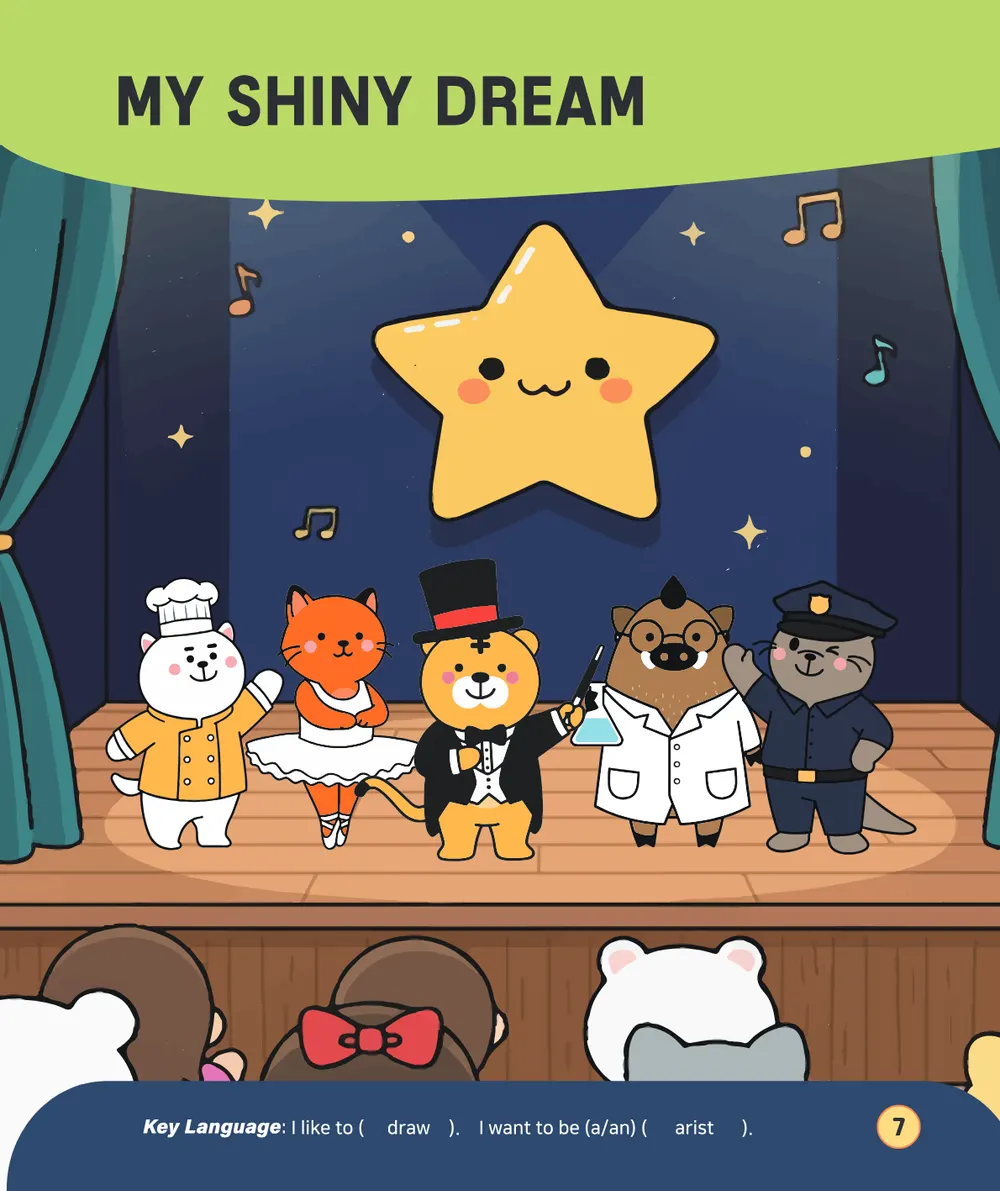
- Show the picture of the characters on stage presenting their future dreams. “Who is this character, what is their dream?” “Where are they now?” “What are they doing?” “Do you want to be a chef like Jindo?” “What character job do you want?”
- Relate the picture to the students’ lives and ask if they know what their dream jobs are, or what their parents do.
3. Introduction to vocabulary (Student Book pg. 8)
- a) Vocabulary Introduction. Clearly pronounce the target words and have students repeat.
- b) Comprehension Check. Ask students if they know the meaning of the words. Encourage explanations in simple English.
- c) Physical Demonstration. Use gestures or actions to illustrate the meaning of each word. Create brief scenarios to contextualize the vocabulary.
- d) Contextual Repetition. “Can you see the chef? What do chefs do? That’s right, they make food.” “This person is a singer, let’s sing together!” “This is an artist — an artist makes art by painting, drawing, writing and many different ways.” “What is this person doing? They are a swimmer; this can be a sport or a job where you save people.” “The person with the funny hat is an engineer. An engineer is someone who designs and draws things we use every day like houses, computers, machinery and cars.”
- e) Personal Connection. “Do you like making art? If so you might want to be an artist like Roo.” “What food would you make if you were a chef like Hoggy?” “Can you swim like Otto, or don’t you like swimming? Where do we swim — in the ocean? In the pool?” “Do you like making things like Jindo, or do you like science? If you like science then you might like being an engineer like Jindo.”
- f) Interactive Practice. Have the class repeat the word several times together. Provide contexts where they must identify the job. Ask students to practice saying the word to a partner.
Workbook page 4: Words
- After introducing and practicing the vocabulary you can see if the students have understood you. Go to workbook page 4 and circle the correct picture related to the dream.
4. Introducing the song (Student book pg. 9)
- “Now, we’re going to sing a song about jobs! Listen carefully!” Play the My Shiny Dream song. Pause after each sentence and have students repeat the words. Play the song again for fun — faster or slower so that students can enjoy it.
W1 P2Read Together 1 + Workbook (Words)
Lesson Goals
- To reinforce students’ understanding of the target job-related vocabulary (artist, singer, engineer, chef, swimmer) through story engagement and visual association
- To develop students’ comprehension and speaking confidence by exploring the story through guided questions and interactive reading
- To connect the story’s theme of dreams and jobs to students’ own interests, encouraging self-expression and participation in English
Students will be able to
- Recognize and say the target vocabulary words when shown pictures or during story discussions
- Identify and describe the main characters and their dreams using simple sentences (e.g. “Roo wants to be an artist”)
- Respond to comprehension questions about the story and express personal preferences using simple English (e.g. “I like to swim,” “I want to be a chef”)
1. Warm-Up
Hello Song · “How are you?” · “How’s the weather today?” · Day of the week check
1. SB pg 8 — vocabulary review
- Review target vocabulary through actions and explanations. Get students to circle the word that you say.
2. Story Time
- a) Character Introduction. Before opening the book: “Today, we’re going to read a fun story! Let’s meet the characters!” Introduce Jindo, Roo, Otto, Hoggy and Tigo using the pictures in the book. You can also imitate the characters and have the students guess which one you are. “What’s this character’s name?” “What is their favorite place?”
- b) Picture Walk (pgs 10-11). Open to page 10. Before reading the text, focus on the illustrations. “What do you see in this picture?” “Where are they?” (Prompt by asking “Are they in a playground? Do you like the playground?”) “Who is the character behind the tree, do they look like a good character?” (The character is the dream thief.)
3. Interactive Reading — Student Book
- Read the story aloud, one page at a time. Read slowly and clearly. Pause after each sentence or short phrase.
- pg 10-11: have a look at the picture and ask students to identify all the different characters and what their dreams are. Circle the character behind the tree and ask the students who they think this is.
- pg 12-13: have the students find what the characters can’t remember (their dreams). Have them say it out loud together so that the central theme of the story is reinforced.
- pg 14: find what Roo likes to do together with the students and ask them if they like to draw or create art.
- pg 15: circle Tigo’s dream and speak with the students about how Tigo wants to be a singer.
- pg 16: find what Jindo likes to do. Jindo likes to build things — ask students if they have ever built anything.
- pg 17: circle Hoggy’s dream, speak about being a chef, and ask them if they want to be a chef.
- pg 18: find what Otto likes to do. Otto likes to swim — ask students if they like to swim. Reinforce the action of swimming by physically demonstrating it.
4. Reinforce vocabulary
- Look at the vocabulary on each page before you do the reading. The students will practice sight words by doing this.
- pg 14: ask them if they know what Roo’s dream is, using the picture provided. Practice saying ‘artist’ together.
- pg 15: ask them if they know what Tigo’s dream is. Practice saying ‘singer’ together.
- pg 16: ask them if they know what Jindo’s dream is. Practice saying ‘engineer’ together.
- pg 17: ask them if they know what Hoggy’s dream is. Practice saying ‘chef’ together.
- pg 18: ask them if they know what Otto’s dream is. Practice saying ‘swimmer’ together.
- Allow them to engage as a whole so they don’t feel pressured to speak.
5. Wrap-up
- Finish the class with the Goodbye song.