
Roo Station / UNIT 07 RO07
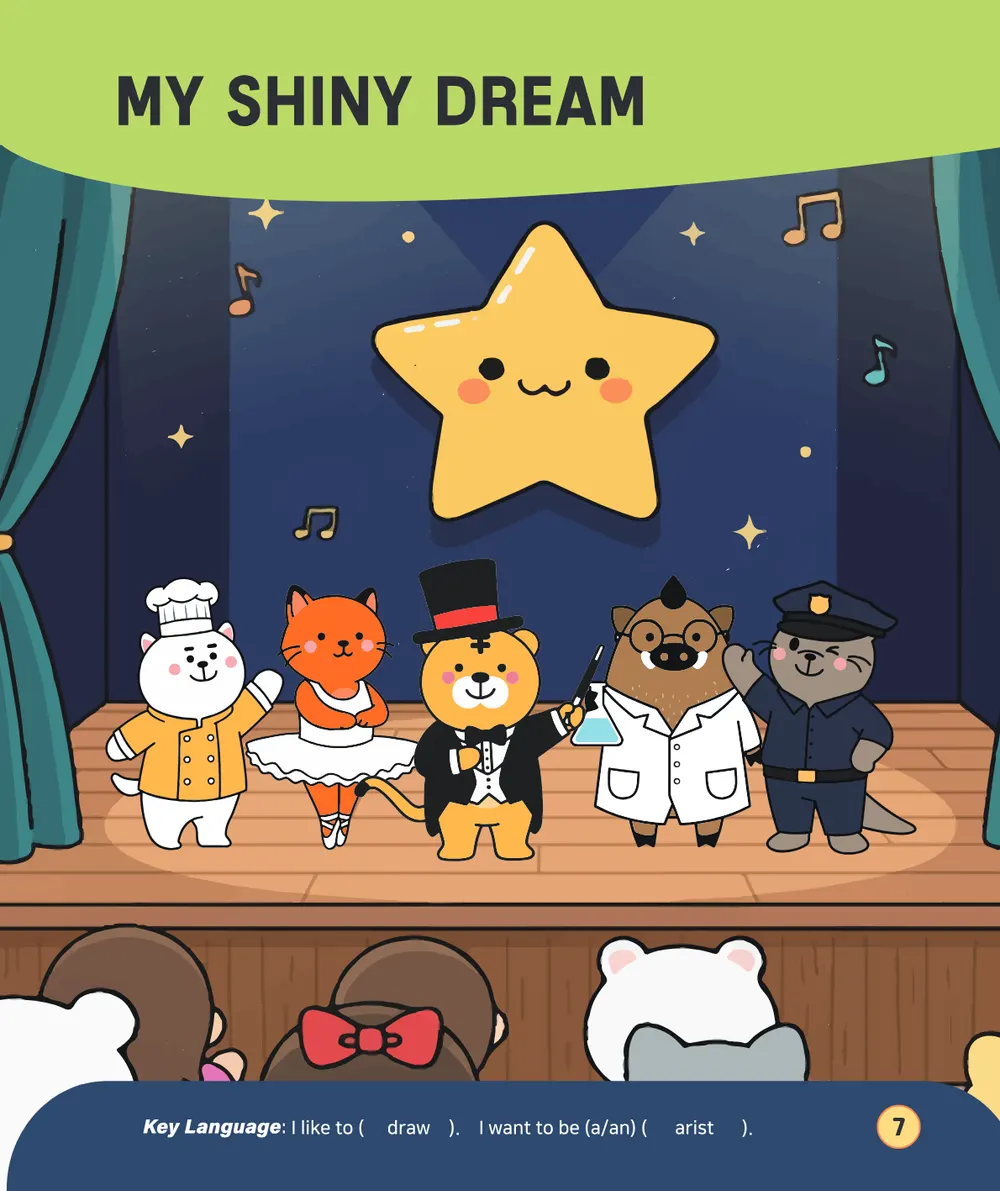
My Shiny Dream
I like to (draw).
 LESSON 2
LET’S GET STARTED
Story Review and Skills
Follow the shared lesson flow, with room to repeat, pause and play.
Start presentation Slides, audio and teaching notes in one place.Your lesson flow
Week 1 · Day 2- 01Routine
Hello & warm-up
Greetings, feelings, weather and the day.
- 02SB
story time; review the story in full & check comprehension
Student Book · p. 10–25
- 03SB
skills
Student Book · p. 26
- 04WB
story
Workbook · p. 5–6
SING · MOVE · PLAY
A little more play
Built into your lesson. Repeat or skip to suit your class; keep time for the book and conversation.
More official songs & online games
Preview external pages before class. They open in a new tab and may need internet or show provider content.
- Walking Walking · movement song ↗Use before seated book work. Model actions in place.
- Starfall ABCs · letter exploration ↗Choose the lesson’s letter with your class. Best after introducing its sound.
- British Council · word games ↗Select the topic first; reading tasks need teacher help for beginners.
Our games add oral practice to the curriculum. They do not measure a child’s English level.
Teaching guide
Original Teacher’s Guide. Each 40-minute lesson covers two guide periods.
2. Story Review and Skills
W1 P3Read Together 2 + Story Review
Lesson Goals
- To strengthen students’ comprehension and recall of the story and its main ideas through guided reading and discussion
- To reinforce understanding of the target vocabulary and connect it to story events and students’ personal experiences
- To encourage expressive communication and confidence in English through story-based interaction, questioning and reenactment
Students will be able to
- Recognize and recall target vocabulary and characters’ dreams when shown pictures or story prompts
- Describe story events and characters’ actions using simple English (e.g. “Jindo is pointing,” “The dream thief took dreams”)
- Participate actively in story reading and reenactment, using gestures, expressions and key words appropriately
1. Warm-Up
Hello Song · “How are you?” · “How’s the weather today?” · Day of the week check
1. Warm-Up
- Let’s Chant song (Student book pg. 9).
3. Student book pg 8
- Review target vocabulary through actions and explanations.
4. Picture Walk (Student Book page 19-25)
- Open to page 19. Before reading the text, focus on the illustrations. Go through each page (19-25), one at a time.
- For each picture, ask open-ended questions: “What do you see in this picture?” “What is so bright?” “What is Otto’s dream?” “What does Tigo want to do?” “Where are they on this page?” “Who is the character that is taking their dreams? Are they a good character?” (The character is the dream thief.)
- Reinforce vocabulary — pg 19: ask them what they think is so bright. First explain what bright means and try to demonstrate it physically using the lights in the classroom.
- pg 22-23: ask them if they know who the characters are and what their dreams were, so students recall the vocabulary and use it in the context of the story.
- pg 24-25: look at the pictures of what the dream thief could dream of. Ask the students if they know what this dream is. If they don’t, practice saying the words together and provide demonstrations or examples.
3. Interactive Reading — Student Book
- Read the story aloud, one page at a time. Read slowly and clearly. Pause after each sentence or short phrase.
- pg 19: find what Jindo is pointing at and tell the students it’s so bright. Ask them to tell you what they think Jindo is pointing at, to get everyone’s input and have them interact with the story.
- pg 22-23: help them make the connection if they can’t do it on their own. Discuss why the dream thief took their dreams.
- pg 24-25: find what the dream thief could be. Discuss each option in detail and elicit responses from the students about the different dreams. Relate the responses to them individually and ask them if they have that dream, or what their dream is.
5. Story Review
- a) “Let’s look at the story again and remember what happened.”
- b) Open the Student Book to page 10 and go through each page until page 25.
- c) For each page, ask key questions related to the pictures and events.
6. Story reenactment
- Assign characters to different students (give everyone a chance) and physically act out the story. Have lots of enthusiasm and encourage the students to be enthusiastic and have fun.
7. Wrap up with the Chant on Student book pg. 9
- a) Relate each sentence to the story.
- b) “Who wants to be an artist, who wants to be an engineer?”
- c) Have the students stand up while singing and encourage them to move their bodies.
W1 P4Workbook (Story) + Story Book (Skills)
Lesson Goals
- To strengthen students’ comprehension of the story and vocabulary by connecting written sentences, stickers and visuals
- To develop students’ number recognition and pronunciation skills through guided practice and repetition
- To promote listening comprehension and physical engagement through a fun and interactive numbers game
Students will be able to
- Match and identify the correct dream with each character using visual and written prompts
- Recognize, pronounce and read aloud the numbers 41 to 50 accurately
- Listen and respond appropriately to spoken numbers by performing the correct physical action during the numbers game
1. Warm-Up
Hello Song · “How are you?” · “How’s the weather today?” · Day of the week check
1. WB pg 5-6 — Story activity
- a) Go to workbook page 5 and look at the sentences. Select the correct response from the students and have them circle it in their books. Read the sentences together and interact enthusiastically to get them to choose the correct option.
- b) Workbook page 6. Use the stickers provided in the book to have the students put the correct dream on the correct character. Encourage individual work; when everyone is complete, go through the answers together. Review each vocabulary word as it is introduced by asking the students about the dream.
2. Skills (Student book pg. 26)
- a) Open the student book to page 26. There is a counting activity that focuses on the numbers 41-50.
- b) First write the numbers large on the board so that students can see them.
- c) Ask them if they know what these numbers are before you go over it all together.
- d) Focus on each number at a time and its pronunciation. Break the number into two separate pronunciations to make it easier. First focus on saying the number 40, practicing it enough times that everyone is comfortable saying and recognising it. Do the same with 50. Then go to the second number — 1, 2, 3, 4, 5, 6, 7, 8, 9 — and practice saying these together.
- e) After practising the numbers separately it’s time to join them together. Explain that the numbers are together, so they are one and must be said together. Go over each number and have the students repeat after you, as many times as necessary until they understand the number and can sight read it.
- f) To make things fun, write the numbers on the board and point to one. Have the students say that number; increase the speed or slow it down to increase the fun.
- g) Look at the picture on Student Book page 26. Count the characters together, and when you reach the character have the students write the number in the correct box below on the page. This reinforces the numbers practiced previously.
3. Numbers Game
- a) To practice all the numbers learnt you can play a game that focuses on listening as well as physical movement.
- b) Explain the rules: when they hear a number said by the teacher they must jump up. When they hear a number that was not learnt they must sit down.
- c) Play the game together with the students. You can increase the speed to make it more fun, or say funny things instead of a number to try to trick them.
- d) Do several rounds. You can eliminate students who get it wrong and have multiple rounds, or run it for a set time period. Give the students a chance to lead the game and call out a number or trick word.