
Roo Station / UNIT 07 RO07
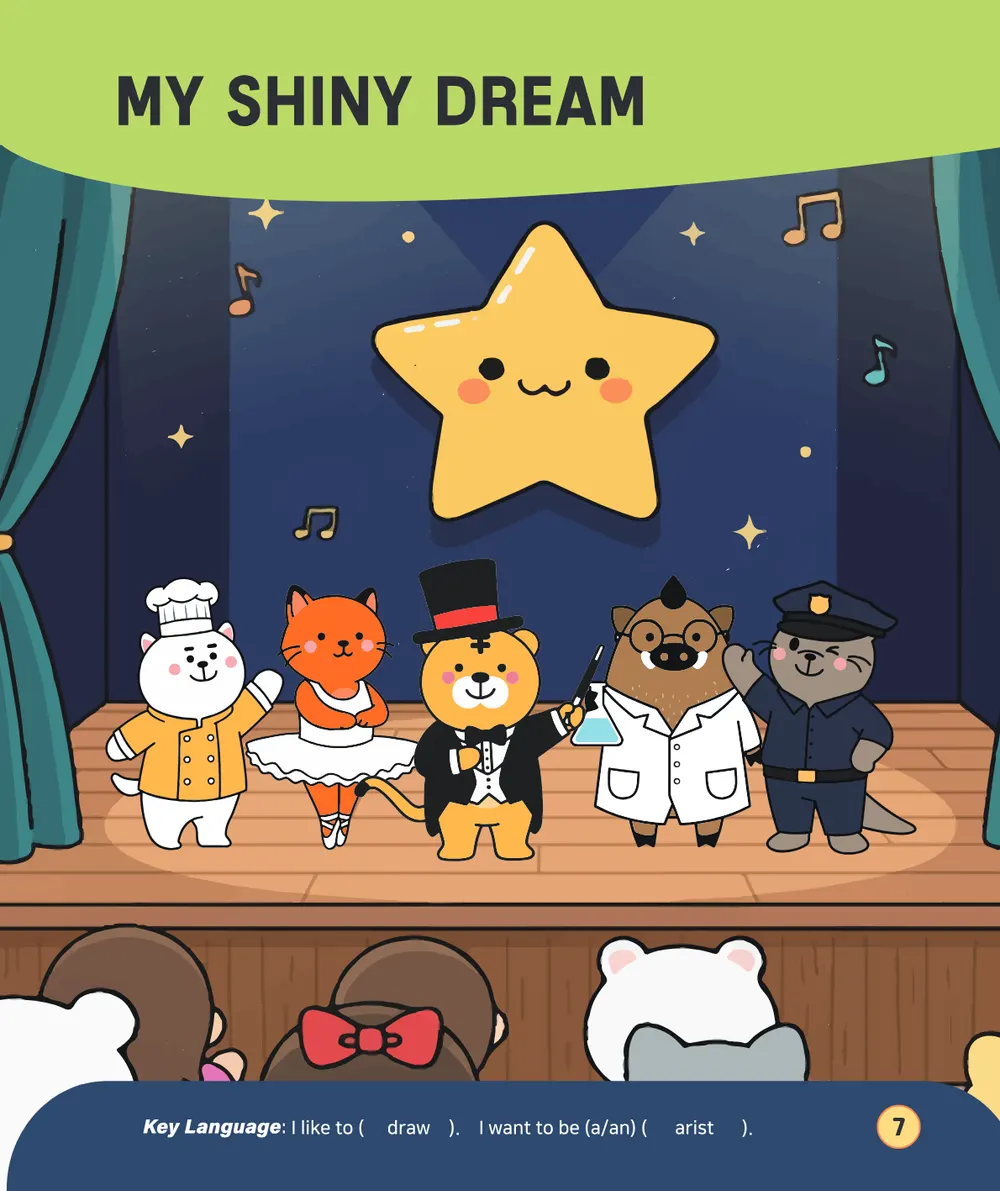
My Shiny Dream
I like to (draw).
 LESSON 3
LET’S GET STARTED
CLIL and Phonics
Follow the shared lesson flow, with room to repeat, pause and play.
Start presentation Slides, audio and teaching notes in one place.Your lesson flow
Week 2 · Day 1- 01Routine
Hello & warm-up
Greetings, feelings, weather and the day.
- 02SB
story review, brief
Student Book · p. 10–25
- 03SB
CLIL, Letter to my future self
Student Book · p. 27
- 04WB
phonics
Workbook · p. 7–8
SING · MOVE · PLAY
A little more play
Built into your lesson. Repeat or skip to suit your class; keep time for the book and conversation.
More official songs & online games
Preview external pages before class. They open in a new tab and may need internet or show provider content.
- Walking Walking · movement song ↗Use before seated book work. Model actions in place.
- Starfall ABCs · letter exploration ↗Choose the lesson’s letter with your class. Best after introducing its sound.
- British Council · word games ↗Select the topic first; reading tasks need teacher help for beginners.
Our games add oral practice to the curriculum. They do not measure a child’s English level.
Teaching guide
Original Teacher’s Guide. Each 40-minute lesson covers two guide periods.
3. CLIL and Phonics
W2 P1Student Book — Read together review + Student Book (CLIL)
Lesson Goals
- To reinforce students’ understanding of the story My Shiny Dream by reviewing characters, settings and key ideas through guided questioning and visuals
- To develop students’ speaking confidence by using familiar daily expressions related to feelings, weather and days of the week
- To encourage creativity and self-expression through a CLIL activity in which students imagine and describe their future dreams in a letter format
Students will be able to
- Recall and answer key story questions (e.g. characters, dream thief, dreams) using simple English with visual support
- Respond accurately to routine warm-up questions (“How are you?”, “How’s the weather?”, “What day is it?”) using complete phrases
- Create a “Letter to Future Me” that includes their dream job, a personal preference and a future hope, accompanied by a matching drawing
1. Warm-Up
Hello Song · “How are you?” · “How’s the weather today?” · Day of the week check
2. Brief Story Review
- “Let’s quickly remember our My Shiny Dream.” Open the Student Book to page 10 and quickly flip through pages 10-25, pointing to the pictures.
- Key questions, pausing after each to allow students time to answer: “What is Jindo’s dream?” “Who is this character behind the tree?” “Why did the dream thief steal their dreams?” “Do you want to be an artist like Roo?” “What does an engineer do?” “Where are the friends in this story?”
3. CLIL (Student book pg. 27) — Letter to future me
- Materials needed: A4 paper or a letter template, crayons or colored pencils, envelopes (optional).
- a) Begin by reviewing the story: “What do the friends want to be?” → chef, singer, artist, engineer, swimmer.
- b) Ask students: “What do you want to be in the future?” Encourage them to say “I want to be a ___.”
- c) Students draw themselves in their future jobs — wearing a chef’s hat, holding a microphone, swimming in a pool.
- d) Guide them to write a short letter to their future self: “Dear Future Me, I am 7 years old now. I want to be a singer. I hope I can sing on stage! Love, [Name]”
- e) When finished, students can share their letters and drawings with the class.
- f) (Optional) Put letters in envelopes to “open in the future”.
- g) Write the frame on the board and explain it so that students understand what to write: “I want to be a ___.” “I like ___.” “Dear Future Me, I hope I can ___. Love, [name]”
4. Finish the class
- Finish with the chant in Student book pg. 9.
W2 P2Phonics (Workbook)
Lesson Goals
- Students will recognize and differentiate between the short vowel sounds /ɪ/ and /ɛ/ and the long vowel sound /aɪ/
- Students will understand and correctly pronounce vocabulary words (kite, pine, bite) associated with the phonics pattern i+e
- Students will connect new vocabulary to personal experiences through gestures, actions and speaking practice
Students will be able to
- Identify the letters I and E, and explain that “i+e” makes the long /aɪ/ sound in words
- Accurately pronounce and act out the target vocabulary words kite, pine and bite with correct vowel sounds
- Demonstrate comprehension of meaning by responding to personal and picture-based questions using short spoken answers and gestures
1. Warm-Up
Hello Song · “How are you?” · “How’s the weather today?” · Day of the week check
1. Introduce the Letters: Workbook pg 7
- a) Write uppercase “I” and lowercase “i” on the board. Write uppercase “E” and lowercase “e” on the board. Write “i + e” together and underline it.
- b) Explain: “These are the letters I and E. Sometimes when we put i and e together in a word, they make the long /aɪ/ sound — like in kite, pine and bite!”
- c) Model, and have the students repeat so they recognize the letters. Say each sound clearly: “I says /ɪ/, E says /ɛ/, and i + e says /aɪ/.” Have students repeat several times, using hand gestures to show short and long sounds.
2. Demonstrate Pronunciation
- a) For the “I” sound: “The letter I makes the /ɪ/ sound.” “Your mouth is open a little and your tongue is in the middle — /ɪ/.” “/ɪ/ like in sit, /ɪ/ like in pig, /ɪ/ like in milk.” Practice these words several times, focusing on correct mouth shape and sound.
- b) For the “i+e” sound: “When we put i and e together, they make the long /aɪ/ sound — like your eyes!” “Put your finger to your eye and say /aɪ/ — eye!” “/aɪ/ like in kite, /aɪ/ like in pine, /aɪ/ like in bite.” Have students repeat several times, exaggerating the long vowel sound.
3. Vocabulary Practice and Actions
- Kite — pretend to hold a string and fly a kite in the air. Say: “Fly a kite! The kite goes up!” Pine — stretch your arms tall like a tree. Say: “A pine tree is tall!” Bite — pretend to bite an apple. Say: “Bite! Bite an apple!” Encourage students to copy your actions.
4. Connect Vocabulary to Students’ Lives
- For kite: “Do you fly kites in spring? What color is your kite?” For pine: “Have you seen a pine tree? Are pine trees big or small?” For bite: “Do you bite apples? Can you show me your best bite?” Encourage short answers and gestures.
5. Workbook activity pg 8
- Do the activity together: trace the path and every time you get to a word practice saying it together. Practice changing the word together by adding a magic E. Read and repeat the magic E word, and when you do so have students place the sticker down onto the page to reinforce the sound that it makes.
6. Phonics action game
- a) Review the words: point to each word in the workbook and have students repeat clearly while doing the matching action. Kite — fly a kite motion. Pine — stand tall like a tree. Bite — pretend to bite food.
- b) Explain the game: the students need to do the assigned action when they hear the word.
- c) Play the game: say a word and have the students do the associated action. “Kite!” (students fly their kite.) Do several rounds. Make it harder: “Now, when I say the sound /aɪ/, you can do any of the actions for kite, pine or bite!” Repeat multiple rounds, encouraging students to listen carefully and move expressively.
6. Wrap-up
- Finish the class with the “Goodbye Song”.