
Roo Station / UNIT 03 RO03
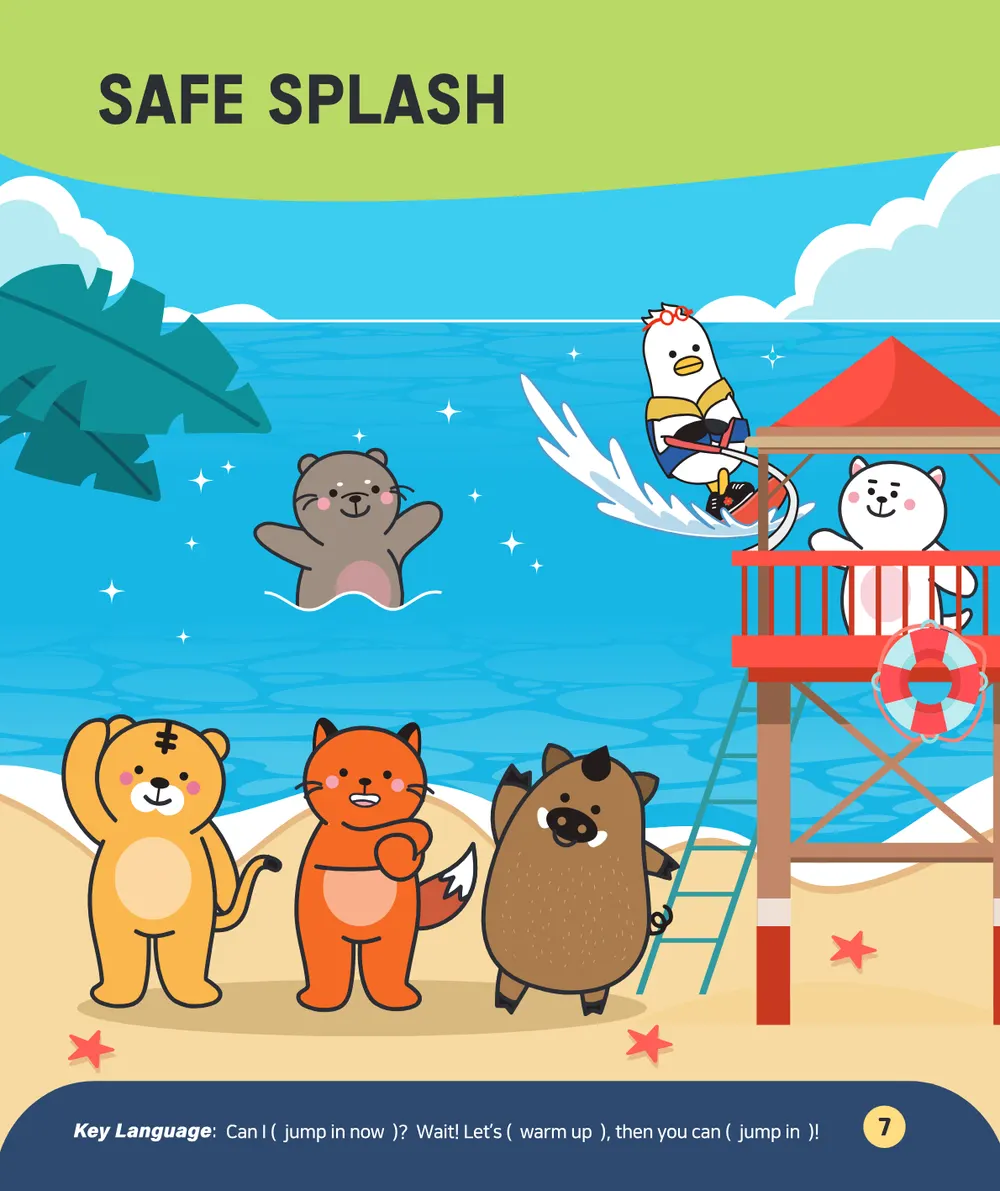
Safe Splash
Can I (jump in now)?
 LESSON 3
LET’S GET STARTED
CLIL and Phonics
Follow the shared lesson flow, with room to repeat, pause and play.
Start presentation Slides, audio and teaching notes in one place.Your lesson flow
Week 2 · Day 1- 01Routine
Hello & warm-up
Greetings, feelings, weather and the day.
- 02SB
story review, brief
Student Book · p. 10–23
- 03Optional
CLIL water safe poster
Student Book · p. 25
- 04WB
phonics
Workbook · p. 7–8
SING · MOVE · PLAY
A little more play
Built into your lesson. Repeat or skip to suit your class; keep time for the book and conversation.
More official songs & online games
Preview external pages before class. They open in a new tab and may need internet or show provider content.
- Walking Walking · movement song ↗Use before seated book work. Model actions in place.
- Starfall ABCs · letter exploration ↗Choose the lesson’s letter with your class. Best after introducing its sound.
- British Council · word games ↗Select the topic first; reading tasks need teacher help for beginners.
Our games add oral practice to the curriculum. They do not measure a child’s English level.
Teaching guide
Original Teacher’s Guide. Each 40-minute lesson covers two guide periods.
3. CLIL and Phonics
W2 P1Student Book read together review + Student Book (CLIL)
Lesson Goals
- To help students confidently recall key details from the story Safe Splash by reviewing visuals, answering simple comprehension questions, and using familiar vocabulary
- To build students’ understanding of playing safe through a CLIL activity that encourages comparison, creativity, and the use of descriptive adjectives
Students will be able to
- Answer key comprehension questions about the story and recall key story details and safety actions
- Create a water play safety poster and present their poster
1. Warm-Up
Hello Song · “How are you?” · “How’s the weather today?” · Day of the week check
2. Brief Story Review (Student Book pg 10-19)
- Open Student Book to page 10. Quickly flip through pages 10-19, pointing to the pictures.
- Key Question Q&A: “What did Roo do before jumping in?” (Elicit “Roo warmed up first”.) “What did Jindo check before swimming far?” (Elicit “Checked the flags”.) “What did Boogi do before surfing?” (Elicit “Checked the sky”.) “What did Hoggy do before diving?” (Elicit “Had a rest”.)
3. Water play safety poster
- Students will be prompted to create a water play safety poster, with the different things that need to be done before playing in the water.
- They can colour the posters and create drawings. They should have at least 4 safety actions on their poster. After they are finished making their poster they will present it.
4. Finish the class with the chant (Student Book pg. 9)
W2 P2Phonics (Workbook)
Lesson Goals
- To help students understand the difference between Fl and Pl sounds
- To build students’ confidence in reading and recognizing Fl and Pl words by practicing vocabulary such as Flag, Flower, Plate, Plug through actions, workbook activities, and guided demonstration
Students will be able to
- Understand the difference between Pl and Fl words and complete workbook tasks that involve sticking, circling, and writing
- Categorize phonics words by sound pattern during the sorting game, choosing whether each word belongs in the Pl category or Fl
1. Warm-Up
Hello Song · “How are you?” · “How’s the weather today?” · Day of the week check
1. Introduce the Letters: Workbook pg 7-8
- The guide prints “two new sounds : c and r” and “Model the sounds gr slowly” here — both are another unit’s letters. The examples underneath are Fl and Pl.
- a) Show the letter f and l on the board. Point to the picture (Flag, Flower, Flip). Ask: “What do you see? What words start with Fl?”
- b) Demonstrate Pronunciation. Model the sound Fl slowly: F + L = Fl (like Flag, Flower, Flip). Let students repeat. Model P + l = Pl (like Plate, Play, Plug). Let students repeat. Use arm gestures: Fl = pretend to flip a coin. Pl = act out playing a game.
- c) Explain the meanings — Flag: usually a country’s symbol. Flower: a plant that usually has colourful petals. Flip: to spin something over. Plate: something you eat off of. Play: what you do when doing a game. Plug: something you use to give power to something.
- d) Connect the vocabulary to students: “Do you play games with your friends?” “Do you like flowers?” “Do you know Korea’s Flag?” “Do you use a plate for Ramen?” Let students answer with short words or point to the object.
2. F and W Action Game
- The heading says F and W; the words below are the Fl and Pl set.
- a) Review the words, point to the words in the Workbook and have students repeat clearly.
- b) Add an action to each word. Flag — wave a flag. Flower — smell a flower. Flip — flip a coin. Plate — eat off a plate. Play — act playing a game. Plug — plugging something in.
- c) Explain that when you say the word the students should do the associated action.
- d) Say a word and have the students do the associated action. Make it harder by asking students to do any action associated with the sound and not just the word. Do this multiple rounds and encourage movement and expressiveness.
3. Wrap-up
- Finish the class with the “Goodbye Song”.