
Roo Station / UNIT 02 RO02
Tail Power
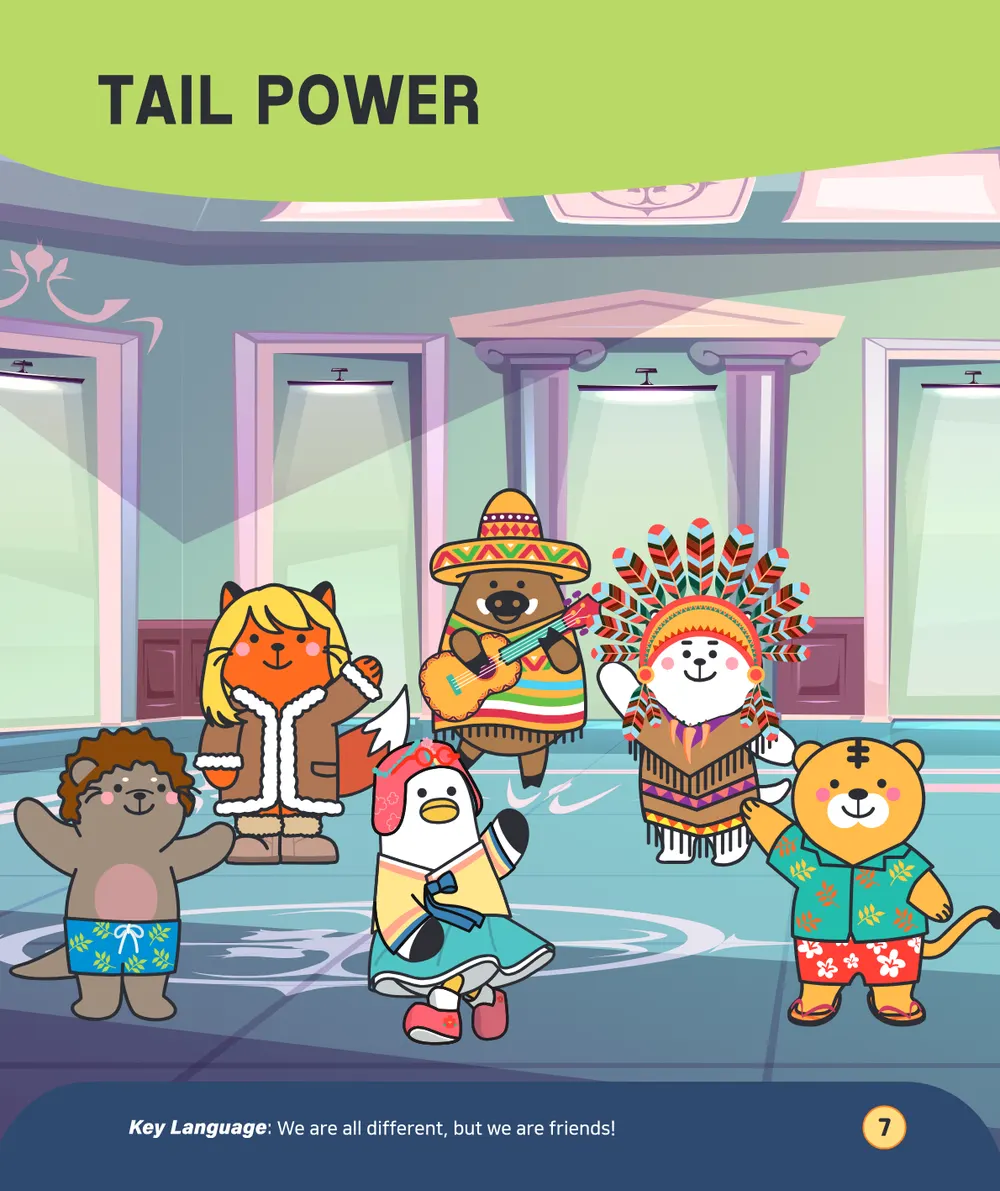
We are all different, but we are friends!
 LESSON 3
LET’S GET STARTED
CLIL and Phonics
Follow the shared lesson flow, with room to repeat, pause and play.
Start presentation Slides, audio and teaching notes in one place.Your lesson flow
Week 2 · Day 1- 01Routine
Hello & warm-up
Greetings, feelings, weather and the day.
- 02SB
story review, brief
Student Book · p. 10–21
- 03Optional
differences
Student Book · p. 23
- 04WB
phonics
Workbook · p. 7–8
SING · MOVE · PLAY
A little more play
Built into your lesson. Repeat or skip to suit your class; keep time for the book and conversation.
More official songs & online games
Preview external pages before class. They open in a new tab and may need internet or show provider content.
- Walking Walking · movement song ↗Use before seated book work. Model actions in place.
- Starfall ABCs · letter exploration ↗Choose the lesson’s letter with your class. Best after introducing its sound.
- British Council · word games ↗Select the topic first; reading tasks need teacher help for beginners.
Our games add oral practice to the curriculum. They do not measure a child’s English level.
Teaching guide
Original Teacher’s Guide. Each 40-minute lesson covers two guide periods.
3. CLIL and Phonics
W2 P1Student Book — Read together review + Student Book (CLIL)
Lesson Goals
- To reinforce students’ understanding of the story Tail Power by reviewing characters, settings and key ideas through guided questioning and visuals
- To develop students’ speaking confidence by using familiar daily expressions related to differences, abilities, friendship, weather and days of the week
- To encourage creativity and self-expression through a CLIL activity in which students imagine and describe their differences and similarities
Students will be able to
- Recall and answer key story questions (e.g. characters, plot) using simple English with visual support
- Respond accurately to routine warm-up questions (“How are you?”, “How’s the weather?”, “What day is it?”) using complete phrases
- Write their friendly superpower such as “I share my snacks”, accompanied by a matching drawing
1. Warm-Up
Hello Song · “How are you?” · “How’s the weather today?” · Day of the week check
2. Brief Story Review
- “Let’s quickly remember the story ‘Tail Power’.” Open the Student Book to page 10 and quickly flip through pages 10-21, pointing to the pictures.
- Key questions, pausing after each to allow students time to answer: “Why did Hoggy fall over?” “Why is Roo sad?” “Why does Roo hide her tail?” “Where are the friends in this story?” “What does the wind do at the festival?” “Do you want to help your friends like Roo?”
3. CLIL (Student book pg. 23) — What’s different?
- Materials needed: A4 paper, crayons or colored pencils.
- a) Begin by reviewing the story: “How are the friends different?” → Roo has a big tail, Tigo has different color socks, Otto has curly hair, Jindo has missing teeth, Hoggy is wearing glasses.
- b) Ask students: “How are you different?” Encourage them to say “I am ____. / I have _____.”
- c) Students draw themselves with one difference — a birthmark, wearing glasses, anything they think makes them different.
- d) Guide them to draw themselves with their differences. Underneath the picture they can write the difference: “I wear glasses.” “I have a birthmark.” “I am from Vietnam.” “I have red hair.”
- e) Draw and write an example picture and sentence on the board so that students understand what to draw or write.
- f) When finished, students can share their drawings with the class.
4. Finish the class
- Finish with the chant in Student book pg. 9.
W2 P2Phonics (Workbook)
Lesson Goals
- Students will recognize and differentiate between the consonant blends /sp/, /sw/ and /sh/ /st/ /sq/ /sm/ /sn/
- Students will understand and correctly pronounce vocabulary words (spin, spoon, spider) associated with the consonant blend /sp/, and (swing, sweep, swan) associated with /sw/
- Students will connect new vocabulary to personal experiences through gestures, actions and speaking practice
Students will be able to
- Identify the letters S and P, and the letters S and W, and understand what sounds they make in words
- Accurately pronounce and act out the target vocabulary words spin, spoon and spider with correct consonant sounds
- Demonstrate comprehension of meaning by responding to personal and picture-based questions using short spoken answers and gestures
1. Warm-Up
Hello Song · “How are you?” · “How’s the weather today?” · Day of the week check
1. Introduce the Letters: Workbook pg 8
- a) Write uppercase “S” and lowercase “s” on the board. Write uppercase “P” and lowercase “p” on the board. Write “s + p” together and underline it.
- b) Explain: “These are the letters S and P. When we put s and p together in a word, they make the /sp/ sound — like in spin, spoon and spider!”
- c) Model, and have the students repeat so they recognize the letters. Say each sound clearly: “S says /s/, P says /p/, and s + p says /sp/.” Have students repeat several times.
2. Demonstrate Pronunciation
- a) For the “S” sound: “The letter S makes the /s/ sound.” “You blow air through your teeth — /s/.” “/s/ like in sit, /s/ like in sun, /s/ like in sock.” Practice these words several times, focusing on correct mouth shape and sound.
- b) For the “s+p” sound: “When we put s and p together, they make the /sp/ sound — like spider.” “Blow air through your teeth and say /s/ — snake!” “Close your lips and then say /p/ like in pie, /p/ like in pine, /p/ like in puppy.” Have students repeat several times, exaggerating the /p/ sound. Put them together and say: “spider, spoon, spin”.
3. Vocabulary Practice and Actions
- Spoon — show a spoon. Say: “Spoon.” Spin — spin an object like a ball on a table. Say: “The ball spins.” Spider — make a spider with your hands. Say: “Spiders crawl! Be careful.” Encourage students to copy your actions.
4. Connect Vocabulary to Students’ Lives
- For spider: “Do you like spiders? Are you afraid of spiders?” For spin: “Can you spin a ball? Can you spin around?” For spoon: “What do you use a spoon for? Can you eat steak with a spoon?” Encourage short answers and gestures.
5. Workbook activity pg 9
- a) Write uppercase “S” and lowercase “s” on the board. Write uppercase “W” and lowercase “w” on the board. Write “s + w” together and underline it.
- b) Explain: “These are the letters S and W. When we put s and w together in a word, they make the /sw/ sound — like in swing, sweep and swan!”
- c) Model, and have the students repeat. Say each sound clearly: “S says /s/, W says /w/, and s + w says /sw/.” Have students repeat several times, using hand gestures to show short and long sounds.
- For the “s+w” sound: “Blow air through your teeth and say /s/ — swim.” “Make a kissing shape with your mouth, say ‘ooo’, then smile and say /w/ like in wet, /w/ like in wine, /w/ like in water.” Put them together and say: “swing, sweep, swan”.
- Swing — draw a swing on the whiteboard. Say: “Swing.” Sweep — do a sweeping action with a brush. Say: “I’m sweeping.” Swan — point to a picture of a swan. Say: “Swans are white and swim on water.”
- For swan: “Do you like swans? What color are they?” For sweep: “Can you sweep the floor?” For swing: “Do you like playing on the swing?”
6. Wrap-up
- Finish the class with the “Goodbye Song”.