
Roo Station / UNIT 02 RO02
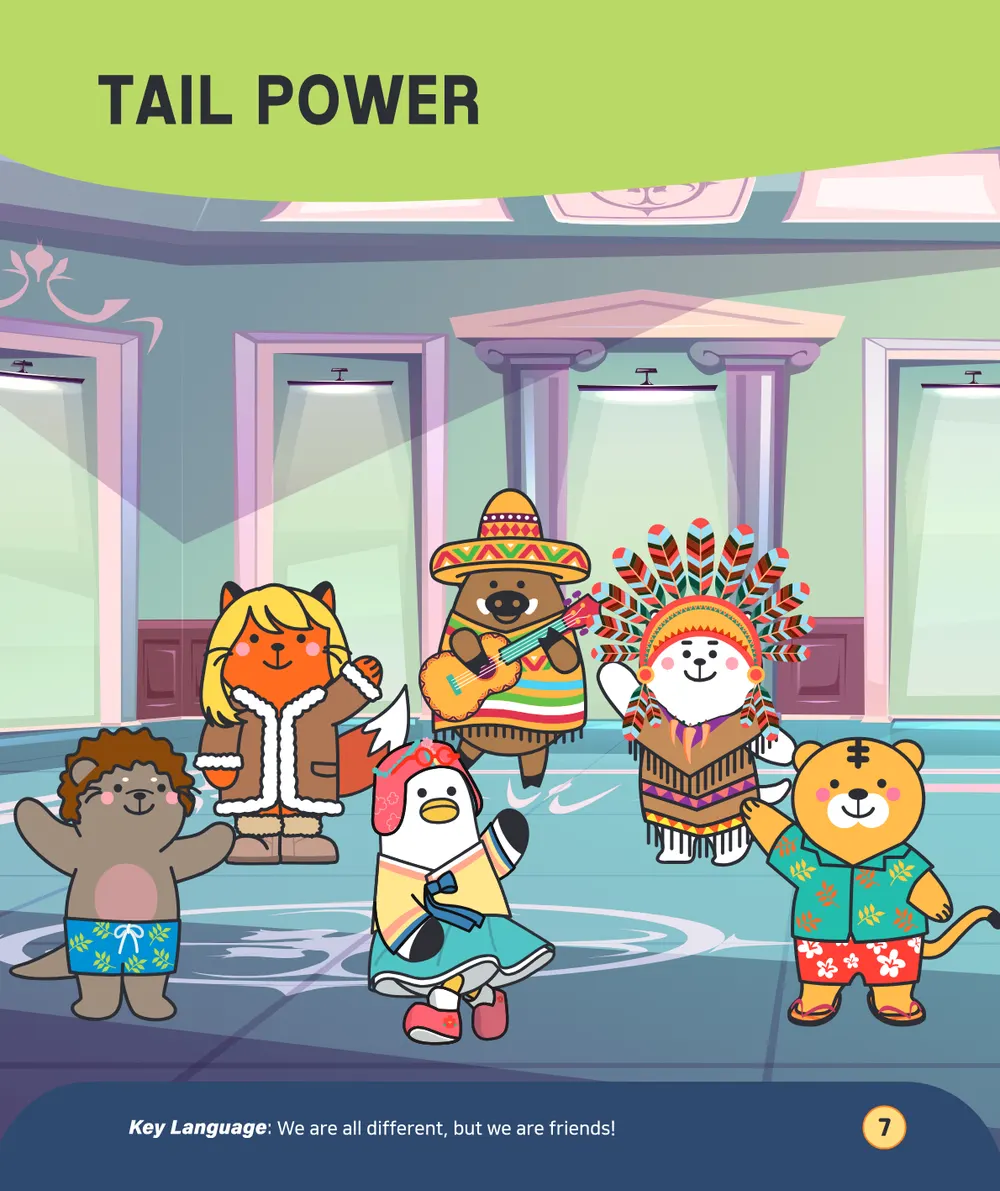
Tail Power
We are all different, but we are friends!
 LESSON 4
LET’S GET STARTED
Make Together and Review
Follow the shared lesson flow, with room to repeat, pause and play.
Start presentation Slides, audio and teaching notes in one place.Your lesson flow
Week 2 · Day 2- 01Routine
Hello & warm-up
Greetings, feelings, weather and the day.
- 02SB
stickers
Student Book · p. 25
- 03WB
stickers/review
Workbook · p. 9–11
Make together
fan · Prepare materials before class.
SING · MOVE · PLAY
A little more play
Built into your lesson. Repeat or skip to suit your class; keep time for the book and conversation.
More official songs & online games
Preview external pages before class. They open in a new tab and may need internet or show provider content.
- Walking Walking · movement song ↗Use before seated book work. Model actions in place.
- Starfall ABCs · letter exploration ↗Choose the lesson’s letter with your class. Best after introducing its sound.
- British Council · word games ↗Select the topic first; reading tasks need teacher help for beginners.
Our games add oral practice to the curriculum. They do not measure a child’s English level.
Teaching guide
Original Teacher’s Guide. Each 40-minute lesson covers two guide periods.
4. Make Together and Review
W2 P3Student Book (Make Together)
Lesson Goals
- Students will build confidence in basic daily English by practicing greetings, feelings, weather and days of the week through songs and routine interactions
- Students will develop simple speaking skills by describing colors, materials and personal choices during the craft project
- Students will express themselves creatively while completing the rotating picture craft and sharing it proudly with classmates
Students will be able to
- Say short routine sentences such as “I’m happy,” “It’s sunny,” and “It’s Thursday” with teacher support
- Describe parts of their craft using simple vocabulary (e.g. “This part is blue,” “I’m using glue,” “I made a cowboy”)
- Confidently participate in a short show-and-tell, introducing their finished craft with one or two simple sentences and responding to applause positively
1. Warm-Up
Hello Song · “How are you?” · “How’s the weather today?” · Day of the week check
2. Student book pg 24 — introduce the project
- a) Introduce the craft and how to do it. Ask students: “What will this craft do?” “How will it work?” “Do you understand how to make it?” Do it together with the students and help them if necessary. Ask as needed: “Do you need help?” “Should I explain again?”
- b) Making a rotating characters craft.
3. During the craft
- Ask questions such as: “Are you enjoying the craft?” “Can you describe what you’re making?” “What colors are you using?” “What materials are you using?” “Is this craft easy or hard for you?” “Are you having fun?”
4. Afterwards
- Ask students: “Who is your favorite character in the craft?” “How many characters are there?” “Which is your favorite costume?”
5. Show and tell
- Have a show and tell where students introduce their craft to their friends. Focus on simple phrases such as “the shoes are pink” or “this part is blue”. Be sure to congratulate them afterwards and get the other students to applaud so that they don’t feel nervous showing their craft.
W2 P4Review — Student Book + Workbook (I Can Say)
Lesson Goals
- To review and reinforce vocabulary related to differences and festivals (tail, different, wind, sweep, messy, flag, help) through interactive speaking and movement activities
- To encourage students to express their own differences and communicate simple sentences in English
- To promote listening comprehension and active participation through vocabulary games and partner interactions
Students will be able to
- Identify and act out vocabulary words using matching actions during the “Good Friends” game
- Draw and describe their own differences/strengths, asking and answering questions with a partner using simple sentences
- Respond accurately to flashcards and teacher prompts, demonstrating understanding of related vocabulary
1. Warm-Up
Hello Song · “How are you?” · “How’s the weather today?” · Day of the week check
2. Workbook pg 10 — Review
- Ask students: “How should friends treat each other?” Get students to stick the correct stickers of the friends being friendly to Roo over the stickers of the friends blaming Roo. Finally place the happy Roo picture over the sad Roo.
- When finished, review the various pictures together as a class. Ask students how Roo feels now that his friends are nice to him.
3. Workbook pg 11 — Review
- Find and circle three differences in the pictures. Let students do this by themselves and then engage with the class as a whole and ask what the differences are.
4. Workbook pg 12 — I Can Say
- Explain to the students that they should work in pairs. Draw their friendly power and say it to their partner. Go around and check whether students need help with spelling or English vocabulary. Practice speaking it with them if they don’t know the word. After they are finished they should ask a friend what their power is and have the friend ask them back.
- Materials needed: crayons or colored pencils.
- Begin by reviewing the story: “What is a good friend? A good friend……” → helps, shares, cares, listens, waits.
- Write the following on the board and explain it so that students understand what to write: “I share my snacks”, “I listen to my friend”, “I wait for my friend”, “I help my friend”, “I make my friend laugh”.
- Ask students: “What is your special power?” Encourage them to say “A good friend ___.” Students draw their friendly power — sharing snacks, helping a friend, listening to a friend. When finished drawing, students can say their powers to their partners.
5. Vocabulary game (Good Friend Charades)
- a) Preparation: clear some space so students can move safely. Prepare picture flashcards of good friend actions that students can act out — share snacks with a friend, care for a friend, listen to a friend, wait for a friend, make a friend laugh, help a friend with homework.
- b) Review the vocabulary with actions before starting. Help — pretend to help with schoolwork. Share — pretend to share snacks. Listen — pretend to listen to a friend. Laugh — pretend to make friends laugh. Care — pretend to take care of a friend. Wait — pretend to wait for a friend.
- c) Warm-up review: hold up each flashcard and say the word clearly. Students repeat after you and do the matching action. Then mix them up and go faster — they must listen carefully and respond with the correct motion. Teacher: “Care!” → students pretend to care. “Share!” → students share snacks. “Help!” → students help with schoolwork. Keep energy high and praise them often.
- d) Play the game: students come up one by one in front of the class. The teacher shows them one flashcard that the other students cannot see. The student acts out that action until another student guesses correctly. Then another student comes up and the teacher shows a different action.
- e) Cool-down and review: gather students in a circle. Hold up flashcards one by one and ask “What does this say?” Encourage short answers: “Share!”, “Care!” End by letting everyone say how they would like their friends to treat them, e.g. “I would like my friends to share snacks with me.”
6. Wrap-up
- Finish the class with the “Goodbye Song” and tell the students “See you next week!”