
Boogi Station / UNIT 03 BG03
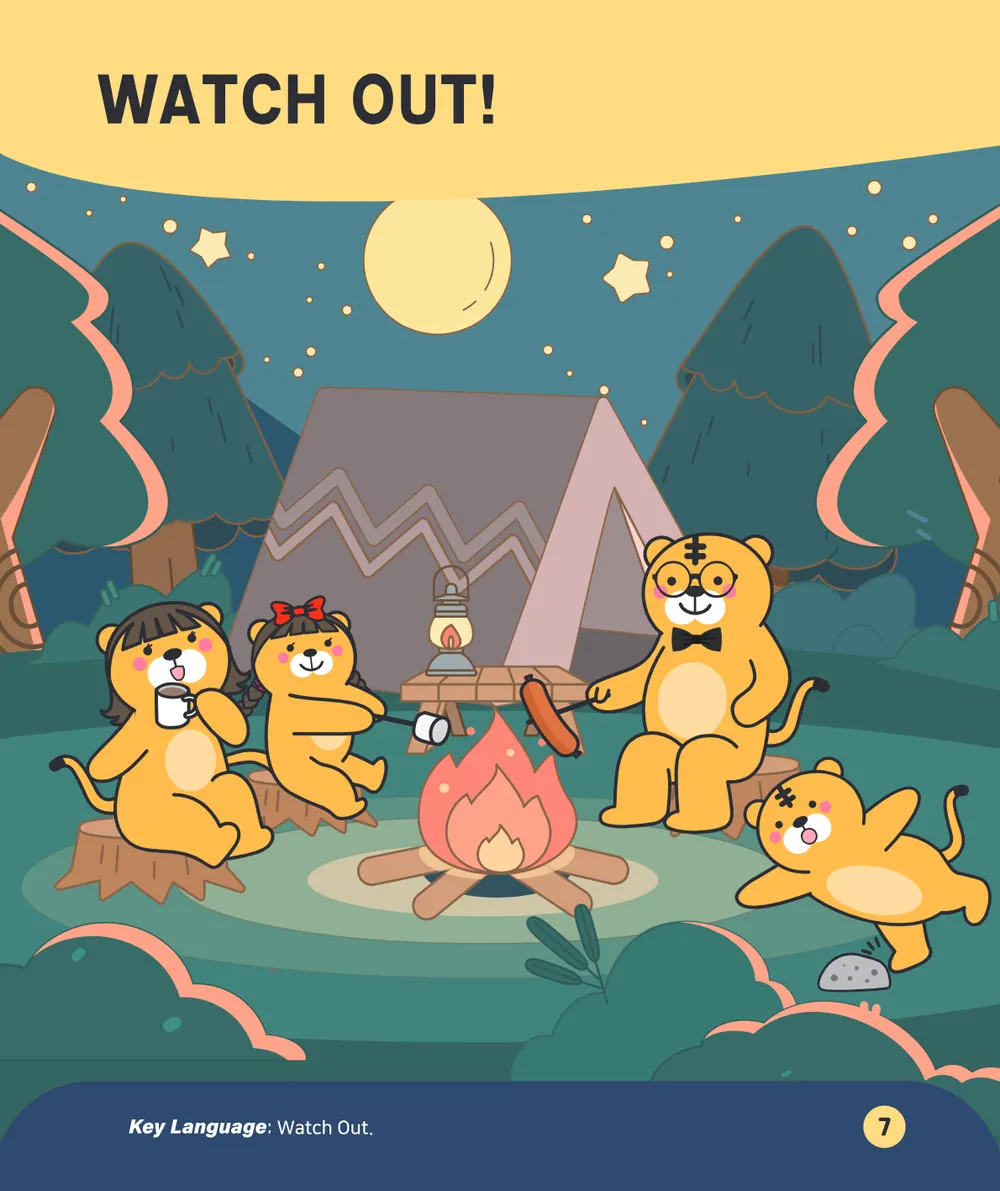
Watch Out!
Watch out!
 LESSON 3
LET’S GET STARTED
CLIL and Phonics
Follow the shared lesson flow, with room to repeat, pause and play.
Start presentation Slides, audio and teaching notes in one place.Your lesson flow
Week 2 · Day 1- 01Routine
Hello & warm-up
Greetings, feelings, weather and the day.
- 02SB
story review, brief
Student Book · p. 10–19
- 03SB
CLIL, connect safety expressions and actions
Student Book · p. 21
- 04WB
phonics
Workbook · p. 8–9
SING · MOVE · PLAY
A little more play
Built into your lesson. Repeat or skip to suit your class; keep time for the book and conversation.
More official songs & online games
Preview external pages before class. They open in a new tab and may need internet or show provider content.
- Walking Walking · movement song ↗Use before seated book work. Model actions in place.
- Starfall ABCs · letter exploration ↗Choose the lesson’s letter with your class. Best after introducing its sound.
- British Council · word games ↗Select the topic first; reading tasks need teacher help for beginners.
Our games add oral practice to the curriculum. They do not measure a child’s English level.
Teaching guide
Original Teacher’s Guide. Each 40-minute lesson covers two guide periods.
3. CLIL and Phonics
W2 P1Student Book read together review + Student Book (CLIL)
Lesson Goals
- To review the safety story and key expressions
- To help students connect safety language with actions
Students will be able to
- Answer simple questions about the story using key safety words
- Respond correctly to traffic light signals (red, yellow, green) with appropriate actions
1. Warm-Up
Hello Song · “How are you?” · “How’s the weather today?” · Day of the week check
2. Story Review (Student Book pg 10-19)
- Say: “Let’s quickly remember our ‘Watch out!’” Open Student Book to page 10. Quickly flip through pages 10-19, pointing to the pictures.
- Key Question Q&A: “Where did the friends go?” (Elicit “the park”.) “What is Tigo surprised?” (Elicit “Otto tripped”.) “What should Jindo do?” (Elicit “Slow down!”) “Where are they now?” (Elicit “the playground”.)
3. CLIL — Guess the Shape (Student Book p 21)
- The heading is another unit’s; page 21 prints “CLIL — Red light, Green light”, which is what the steps below describe.
- Objectives: a) Students will recite safety expressions with appropriate gestures. b) Students will follow the “Red/Green Light” rules and reach the finish line safely.
- Materials: red, yellow and green colour paddles or cards; whistle (optional).
- a) The teacher is the ‘Traffic Light’ at the front and the students are “Pedestrians” at the starting line.
- b) The teacher shouts the colours loudly. “Green light!”: the students run/walk forward. “Yellow light!”: the students walk very slowly (Slow down). “Red light!”: the students must STOP immediately and freeze.
- c) The first student to reach and touch the ‘Traffic Light’ wins and becomes the next light.
- Teacher Tip: Ensure students fully internalize safety phrases such as “Walk slow,” “Slow down,” and “Watch out!” to prevent collisions and maintain order during the game.
4. Wrap-up
- Review target words with the [Let’s Chant] song, then finish the class with the Goodbye song.
W2 P2Phonics (Workbook)
Lesson Goals
- To introduce the phonics sounds F f and W w
- To support early phonics awareness through listening and speaking activities
- To reinforce phonics learning using familiar vocabulary and visuals
Students will be able to
- Identify the sounds /f/ for F f and /w/ for W w
- Recognize words that begin with F f and W w from pictures
1. Warm-Up
Hello Song · “How are you?” · “How’s the weather today?” · Day of the week check
2. Phonics Introduction — F f
- a) Demonstrate Pronunciation. Write uppercase “F” and lowercase “f” on the board. “The letter F makes the /f/ sound.” “To make the /f/ sound, put your top teeth on your bottom lip and blow air out.” “Let’s make the sound together: /f/, /f/, /f/!”
- b) Direct students to the pictures on Workbook page 8. “/f/, /f/, /f/ like in family, /f/, /f/, /f/ like in fan, /f/, /f/, /f/ like in fish.” Family — point to the students and gesture “group of people together.” Fan — wave your hand like air is blowing. Fish — mimic a swimming fish with your hand or make a “fish face.”
- c) Practice saying these words numerous times.
3. Workbook pg 8 — Phonics
- The teacher has students colour the fish by distinguishing between uppercase ‘F’ and lowercase ‘f’ with the designated crayons.
4. Phonics Introduction — W w
- a) Demonstrate Pronunciation. Write uppercase “W” and lowercase “w” on the board. “The letter W makes the /w/ sound.” “To make the /w/ sound, make your lips round, like you are about to blow, and push out the sound.” “Let’s make the sound together: /w/, /w/, /w/!”
- b) Direct students to the pictures on Workbook page 9. “/w/, /w/, /w/ like in wet, /w/, /w/, /w/ like in wind, /w/, /w/, /w/ like in watermelon.” Wet — sprinkle a few drops of water on your hand and say “Wet!” Wind — blow strongly and wave your arms like air moving. Watermelon — mime cutting and eating a big watermelon.
- c) Practice saying these words numerous times.
5. Workbook pg 9 — Phonics
- Point to the zigzag lines and explain that they look like the letter ‘W’, and guide students to trace the three ‘W’ shapes.
6. Activity (Phonics) — Odd One Out
- a) Show four words. Example: Family, fan, fish, wet.
- b) Say the words together.
- c) Find the word that is different.
- d) Say why it is different.
7. Wrap-up
- Review target words with the [Let’s Chant] song, then finish the class with the Goodbye song.