
Boogi Station / UNIT 01 BG01
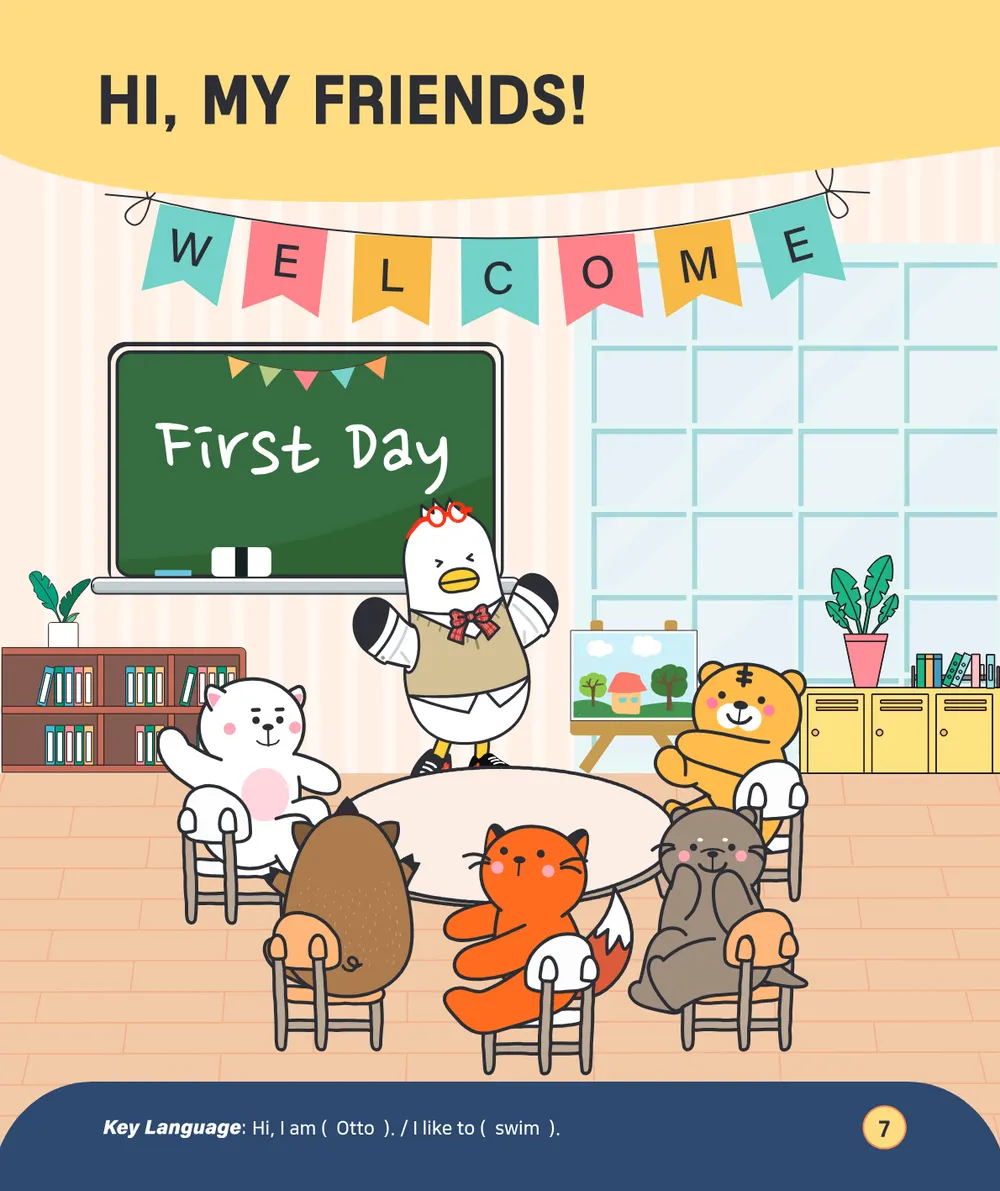
Hi, My Friends!
Hi, I am (Otto).
 LESSON 3
LET’S GET STARTED
CLIL and Phonics
Follow the shared lesson flow, with room to repeat, pause and play.
Start presentation Slides, audio and teaching notes in one place.Your lesson flow
Week 2 · Day 1- 01Routine
Hello & warm-up
Greetings, feelings, weather and the day.
- 02SB
story review, brief
Student Book · p. 10–23
- 03SB
CLIL, connect characters to actions
Student Book · p. 25
- 04WB
phonics
Workbook · p. 8–9
SING · MOVE · PLAY
A little more play
Built into your lesson. Repeat or skip to suit your class; keep time for the book and conversation.
More official songs & online games
Preview external pages before class. They open in a new tab and may need internet or show provider content.
- Walking Walking · movement song ↗Use before seated book work. Model actions in place.
- Starfall ABCs · letter exploration ↗Choose the lesson’s letter with your class. Best after introducing its sound.
- British Council · word games ↗Select the topic first; reading tasks need teacher help for beginners.
Our games add oral practice to the curriculum. They do not measure a child’s English level.
Teaching guide
Original Teacher’s Guide. Each 40-minute lesson covers two guide periods.
3. CLIL and Phonics
W2 P1Student Book read together review + Student Book (CLIL)
Lesson Goals
- To review the story
- To help students connect with what they like to do
Students will be able to
- Answer simple questions about the story and characters
- Identify characters by name and show their actions using body movement
1. Warm-Up
Hello Song · “How are you?” · “How’s the weather today?” · Day of the week check
2. Story Review (Student Book pg 10-23)
- Say: “Let’s quickly remember our ‘Hi, My Friends!’ story.”
- Open Student Book to page 10. Quickly flip through pages 10-23, pointing to the pictures.
- Key Question Q&A — ask key questions, pausing after each to allow students time to answer: “Where are the friends?” (Elicit “the beach”.) “What does Otto like to do?” “What does Jindo like to do?” “Does Hoggy like to eat?”
3. CLIL — Move Like My Friends (Student Book p 25)
- Objective: Students will connect character names with actions.
- a) Teacher Demonstration. T: “Who likes to swim?” (show swimming motion) S: (point to Otto and say) “Otto!” T: “Great! Show me how he swims!” Students act out swimming.
- b) Practice with all characters.
- c) Repeat the question for each character and action: “What does Otto like to do?” → act out playing. “What does Roo like to do?” → drawing. “What does Hoggy like to do?” → eating. “What does Jindo like to do?” → digging. “What does Tigo like to do?” → reading.
- d) Whole-Class Participation. Call out a character’s name only: T: “Move like Roo!” S: (act like they are drawing)
- e) Guess Who? (The Upgrade). Cover a character card with paper. Slowly slide the paper to reveal only a tiny part. T: “Guess who? Who is this?” S: “Hoggy!” T: “Bingo! What does Hoggy like to do?” S: (act out the eating motion)
4. Wrap-up
- Review target words with the [Let’s Chant] song, then finish the class with the Goodbye song.
W2 P2Phonics (Workbook)
Lesson Goals
- To introduce the phonics sounds D d and L l
- To support early phonics awareness through listening and speaking activities
- To reinforce phonics learning using familiar vocabulary and visuals
Students will be able to
- Identify the sounds /d/ for D d and /l/ for L l
- Recognize words that begin with D d and L l from pictures
1. Warm-Up
Hello Song · “How are you?” · “How’s the weather today?” · Day of the week check
2. Phonics Introduction — D d
- a) Demonstrate Pronunciation. Write uppercase “D” and lowercase “d” on the board. “The letter D makes the /d/ sound.” “To make the /d/ sound, put the tip of your tongue just behind your top teeth and push and let go.” “Let’s make the sound together: /d/, /d/, /d/!” Exaggerate the lip and teeth placement.
- b) Direct students to the pictures on Workbook page 8 and point to each image. Say: “/d/, /d/, /d/ like in draw, /d/, /d/, /d/ like in dig, /d/, /d/, /d/ like in desk.” Draw — draw something on the board or mimic drawing and say “Draw!” Dig — mimic a digging motion and say “Dig!” Desk — point to a student’s desk and say “Desk!”
- c) Practice saying these words numerous times. If some students are having difficulty with a certain aspect of pronunciation, focus on that again and again until it is understood.
3. Workbook pg 8 — Phonics
- Point to each balloon and have students repeat the words out loud, and direct students to find the matching stickers and paste them inside the correct balloons.
4. Phonics Introduction — L l
- a) Demonstrate Pronunciation. Write uppercase “L” and lowercase “l” on the board. “The letter L makes the /l/ sound.” “To make the /l/ sound, put the tip of your tongue on the ridge just behind your top teeth and let the air flow out.” “Let’s make the sound together: /l/, /l/, /l/!”
- b) Direct students to the pictures on Workbook page 9. “/l/, /l/, /l/ like in like, /l/, /l/, /l/ like in lion, /l/, /l/, /l/ like in lamp.” Lion — “Do you like lions? What do lions eat? Have you ever seen a lion?” Show a picture of a lion or mimic a lion (claws, roar) and say “Lion!” Lamp — point to a lamp in the classroom or mimic turning a lamp on and off, say “Lamp!” Like — give a thumbs up, heart hands, or smile, and say “Like!”
- c) Practice saying these words numerous times.
5. Workbook pg 9 — Phonics
- Use the workbook to colour the lion, with different colours for uppercase L and lowercase l.
6. Activity (Phonics) — D and L Action Game
- a) Review the words, point to the words in the Workbook and have students repeat clearly.
- b) Add an action to each word. Draw — drawing motion. Dig — digging with a shovel action. Desk — leaning on a table action. Lion — scary lion roar/expression. Lamp — clicking on/off a lamp motion. Like — big smile and thumbs up.
- c) Say a word and have the students do the associated action.
- d) Make it harder by asking students to do any action associated with the sound (/d/ or /l/) and not just the word. Do this multiple rounds and encourage movement and expressiveness.
7. Wrap-up
- Review target words with the [Let’s Chant] song, then finish the class with the Goodbye song.